A clause in the Crime and Policing Bill, inserted in the House of Commons last year, will disapply the existing criminal law for women who access an abortion outside the legal limits.
This means that a woman seeking an abortion outside the terms of 1967 Act – which regulates the term limit – could not be prosecuted for doing so. However providers could still be investigated or prosecuted.
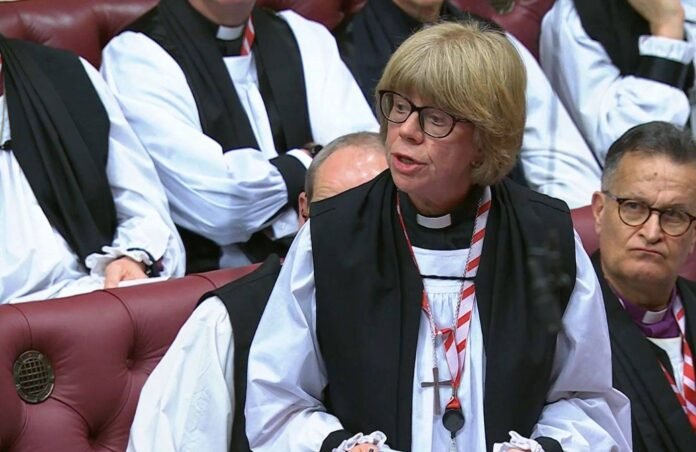
The Archbishop of Canterbury, Sarah Mullally, took part in the debate, alongside the Bishops of Chelmsford, Coventry, Chester, Leicester, Southwell & Nottingham, Portsmouth, Sheffield, Chichester, Hereford and Oxford.
Archbishop Sarah spoke in support of an amendment brought by Lady Monckton, to reject the clause altogether.
“Decriminalisation of abortion is a question of such legal, moral and practical complexity that I do believe it cannot be properly addressed in an amendment hastily added to another bill,” she told Peers.
“Consideration of any alteration to our abortion laws needs public consultation and robust Parliamentary processes to ensure that every aspect of this debate is carefully considered and scrutinised.”
She also spoke in support of amendments from Lady Stroud and the Bishop of Leicester which would reinstate in-person consultations before drugs for the termination of a pregnancy could be prescribed, which were provided before the Covid-19 pandemic. The Bishop of Leicester, Martyn Snow’s amendment related to those under 18.
“Women confronted with the very complex and difficult decision to terminate a pregnancy deserve our utmost understanding, care and practical support as they face what is often a heart wrenching decision,” she said.
“However, I cannot support Clause 208 as it stands.
“Though its intention may not change the 24-week abortion limit, it undoubtedly risks eroding the safeguards and enforcement of those legal limits and inadvertently undermining the value of human life.”
Lady Monckton’s amendment was lost by 185 votes to 148. Full breakdown of the vote.
Bishop Martyn’s amendment fell by 163 votes to 68.
Archbishop Sarah’s speech:
My Lords, many noble Lords will know that the Church of England’s view on abortion is one of principled opposition, recognising that there can be limited conditions under which abortion may be preferable to any available alternatives. This is based on the belief of the infinite worth and value of every human life, however old or young, and including life not yet born. The infinite value of human life is a fundamental Christian principle that underpins much of our legal system and has shaped existing laws on abortion. All life is precious. We therefore need to recognise that women confronted with the very complex and difficult decision to terminate a pregnancy deserve our utmost understanding, care and practical support as they face what is often a heart-wrenching decision.
However, I cannot support Clause 208. Though its intention may not be to change the 24-week abortion limit, it undoubtedly risks eroding the safeguards and enforcement of those legal limits and, inadvertently, undermining the value of human life.
I support Amendment 425 in the name of the noble Baroness, Lady Stroud, since it is not clear how the law can function in an enforceable way without in-person consultation before accessing early medical abortion. The risks of medical complications are, as we have heard, much greater if the pills for early abortion are taken beyond the 11-week limit. Although there are benefits to telemedicine—I do not dispute that—there are also flaws, and they are key to the debate on whether Clause 208 should pass.
As I have already said, this is not a debate on whether the legal abortion limit should change, but without the levers necessary to monitor and enforce the law, we are at risk of it becoming exactly that.
In the same vein, I support the amendment in the name of my right reverend friend the Bishop of Leicester, as we have a particular duty of care to those under 18 to ensure that they are properly cared for and supported while making such difficult decisions.
I am reminded of the call of the prophet Micah both to do justice and to love mercy. Balancing justice and mercy is the challenge that we are debating today. I do not think that women who act in relation to their own pregnancies should be prosecuted, but I also do not wish to see any increase in late-term abortions.
Although Clause 208 is well intentioned, it risks making an already imperfect situation worse. Therefore, I support Amendment 424 in the name of the noble Baroness, Lady Monckton.
Decriminalisation of abortion is a question of such legal, moral and practical complexity that it cannot be properly addressed in an amendment hastily added to another Bill. Consideration of any alteration to the abortion laws needs public consultation and robust parliamentary processes to ensure that every aspect of this debate is carefully considered and scrutinised.
There are many outstanding questions, which deserve greater attention, about the tone of policing in this area, about how we can best ensure that women suffering miscarriages can access the right care when they need it, and about how those who provide abortions outside the law will continue to be held accountable for doing so.
As I have said before in this place, we need a framework that supports women, not one that puts them and their unborn children in the way of greater harm. On that basis, I will support the amendments in the names of the noble Baronesses, Lady Monckton and Lady Stroud, and my right reverend friend the Bishop of Leicester should they push them to a vote.
Bishop Martyn’s speech
My Lords, I shall speak to the amendment in my name, Amendment 426D. I start by thanking the Minister for meeting me a couple of weeks ago to discuss this matter—and I want to be direct at the outset about what the amendment would do and would not do.
The amendment is distinct from Amendment 425, which stands on its own merits, and which your Lordships will consider on its own terms. This amendment says nothing about adult women’s access to abortion, nothing about where medication is taken and nothing about the broader questions that have been part of our debate up till now. It rests entirely on one safeguarding principle—that when a child is the patient, a professional should meet her before prescribing. I believe that that is something that your Lordships can support, regardless of the views that you hold on everything else before the House today.
The amendment is brought on behalf of the National Network of Designated Healthcare Professionals for Children—NHS doctors and nurses who carry statutory safeguarding responsibilities for children across every local safeguarding partnership in England. Its concern is that the needs of children, particularly looked-after children who become pregnant, are not sufficiently accounted for in this clause. Since 2022, a girl of 14 can telephone an abortion service, receive medication by post, take it at home, and no clinician will ever meet her. How does that give confidence that safeguarding risks are being properly assessed? How does the provider of medication know whether there is someone else in the room when they speak to the child on the phone? How do they know whether someone else has suggested that the child should make the phone call? Surely the only safe way to assess risk is to meet in person.
The noble Baroness, Lady Blackstone, says that telemedicine is safe. I fully respect her experience in this field and, in many situations, I would agree, but in the case of children, of which I note she made no mention in her speech, I believe she is wrong. Telemedicine is not safe for children.
Baroness Gerada: Is the right reverend Prelate aware that coercion can also occur in the consultation room, as I have seen many times? It may actually be safer for the girl—or the child, as he is calling her—to be able to choose the place and the time where she has that consultation.
Bishop of Leicester: I am very aware that there are risks to all forms of consultation. My argument is simply that the risks are minimised by in-person consultation.
The considered view of safeguarding professionals in the NNDHP is that the current guidance put in place by the Royal College of Paediatrics and Child Health in 2022 is simply not robust enough. That guidance, I note, requires an in-person meeting for children under 13. Children under 16 are,
“normally … required to complete their consultation in-person, unless there is a compelling indication to do otherwise”.
Evidence, however, suggests that most providers of abortion care are arguing that the option of telemedicine itself is a compelling indication that an in-person consultation is not required. For those aged 16 or 17, the guidance says only that children—and, of course, 16 and 17-year-olds are still children under the Children Act—should “be encouraged” to attend in person. More fundamentally, guidance can currently be changed unilaterally, without parliamentary scrutiny or public consultation, at the discretion of the body that issued it. I believe, therefore, that legislation is required. What Parliament enacts, only Parliament can remove.
The case for this amendment, however, does not rest on my view or the NNDHP’s alone. The Government’s own consultation found that safeguarding organisations specifically identified under-18s as the group for whom in-person assessment was most critical to reduce the risk from those who sexually exploit children, manipulate the system or force their victims to obtain abortion. Indeed, MSI Reproductive Choices has documented that face-to-face appointments are associated with a significant increase in domestic abuse disclosures compared with telemedicine. This is especially significant given that girls and young women face a higher risk of coercive or abusive relationships than those aged over 24, and are often less equipped to ask for help.
The clinical risks compound this. Beyond 11 weeks’ gestation, home management is not appropriate and the risks to the patient increase significantly. As has been mentioned, accurate gestational age assessment is the foundation on which safe prescribing depends, and it cannot be done reliably by telephone. These are not theoretical risks. We have heard stories already. I would simply add that of a 16 year-old who was estimated by the clinic to be under eight weeks pregnant, but the baby she delivered was in fact 20 weeks. She later said, “If they had scanned me and I knew that I was that far gone, I would have had him”. An in-person appointment would have changed everything for that young woman. This amendment would require such an appointment.
I echo the concerns of the noble Baroness, Lady Stroud, in her amendment. Without an in-person consultation, it is unclear how we will ensure that early medical abortions take place within the law. Indeed, challenges around vulnerability and correct gestational assessment apply to adulthood as well, which is why I fully support Amendment 425. Although I have been assured that abortion providers will remain subject to the criminal law if Clause 208 is passed, it is hard to see how this will make a meaningful difference in the case of early medical abortion, since providers who carry out telephone assessments will have met the standard of due diligence required of them. My amendment offers a reminder that the needs of children and young people should be paramount in our thinking and in that of all who work with them, including abortion providers. My amendment asks for one proportionate safeguard: that when a child is the patient, a medical professional meets her before prescribing. I invite noble Lords to consider whether that is really too much to ask.