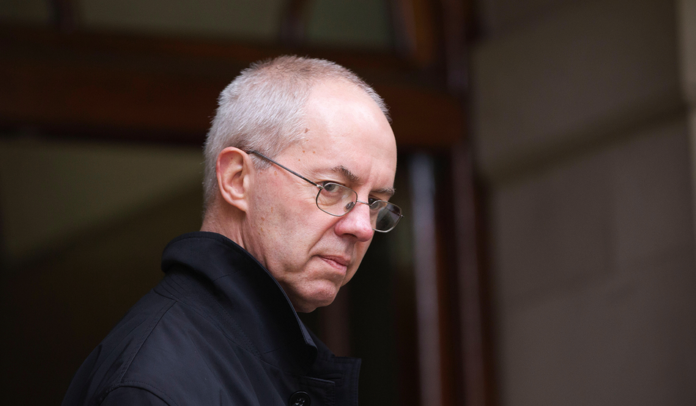
Justin Welby has disclosed that he has been receiving both psychotherapy and psychiatric treatment to help him cope with what he calls his “failure” in handling abuse allegations against the late John Smyth, a scandal that led to his resignation as Archbishop of Canterbury in 2024.
In a recent episode of Gyles Brandreth’s Rosebud podcast, Archbishop Welby confirmed that he has been “seeing a psychotherapist for a considerable period of time” and “a psychiatrist,” describing this support as “very helpful.” He stressed that the purpose of therapy is not to minimize the scandal, but to ask, “how does one live with such a failure?” in light of his responsibility for the Church’s response to the John Smyth abuse scandal
Archbishop Welby said these questions have continued to weigh on him since he stepped down from office, calling the period around his resignation “the loneliest moment” of his ministry. His comments came in the context of a wide‑ranging conversation about failure, humanity and the possibility of redemption.
Archbishop Welby resigned shortly after the publication of the Makin Review in November 2024, which examined the Church of England’s handling of allegations against John Smyth, a barrister and influential conservative evangelical who abused boys and young men over several decades in England and Southern Africa. The review concluded that Smyth was “arguably the most prolific serial abuser to be associated with the Church of England” and found that earlier reports of his behaviour were met with an “active cover‑up” that failed to protect victims.
Investigators found that senior church figures treated Smyth as “a problem solved and exported to Africa,” where further abuse took place. The report stated that Welby bore “personal and moral responsibility” to pursue the matter more energetically once he became Archbishop, and that the Church’s overall response had fallen far short of what victims were entitled to expect.
Following the review, Archbishop Welby publicly accepted that he had “personally failed to ensure” that Smyth’s abuse was “energetically investigated,” and has now reiterated that the criticism that he did not do enough to prioritise victims is “absolutely correct.” At the same time, he has continued to challenge aspects of the Makin report, including its account of when and how allegations were reported to the police.
In his Rosebud interview he repeated his claim, made previously at the Cambridge Union, that the Smyth allegations had in fact been reported to the authorities and that police had asked the Church not to conduct its own inquiry for fear of prejudicing their investigation. This stance has drawn criticism from some survivors and advocates, who argue that Welby’s insistence on disputed details undercuts his expressions of remorse.
Survivors of Smyth’s abuse have reacted cautiously to Welby’s latest comments. One survivor, identified as “Graham,” told GB News that while Welby presents his turn to therapy as a response to “safeguarding failure,” he “then spends the rest of the interview trying to project that he did nothing wrong, need not have resigned, and was subsequently exonerated.” Others have continued to highlight what they see as a culture of secrecy, reputational protection and theological partisanship that allowed Smyth to evade accountability for so long.
Those representing victims, including claimants in ongoing civil actions, maintain that the Church’s failure to report Smyth promptly and transparently to the authorities, and to warn churches in Africa, reflects systemic safeguarding failures rather than isolated misjudgements. For many survivors, the central issue remains not the internal cost to senior leaders, but whether the Church has fully acknowledged the scale of institutional responsibility and implemented robust, independent safeguarding practice.
The Makin Review’s recommendations stress that safeguarding must be understood as the responsibility of the whole Church, with particular accountability resting on senior clergy and national structures. Legal action brought by Zimbabwean survivors similarly alleges that the Church acted to protect its reputation, especially within its conservative evangelical networks, rather than prioritising the safety of children and young people.
Archbishop Welby’s disclosure that he is under psychiatric care underscores the personal toll that safeguarding failures can take on those in leadership, but it also sharpens questions about episcopal accountability and the adequacy of past responses. As civil claims proceed and implementation of the Makin recommendations is watched closely, survivors and many within the wider Anglican world will judge the Church of England not by the private struggles of former leaders, but by concrete changes in culture, transparency and the protection of the vulnerable.