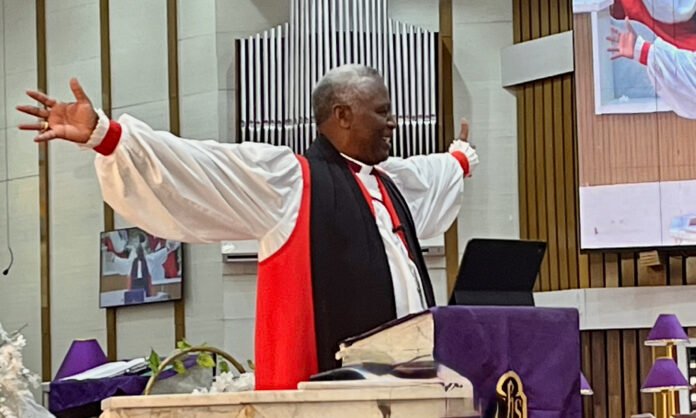
[Abuja, Nigeria] In a stirring call to arms delivered at the Cathedral of the Advent here this evening, Archbishop Laurent Mbanda of Rwanda urged global orthodox Anglicans to reject the false gods of cultural accommodation and institutional self-preservation. Speaking at the close of the GAFCON G26 bishops’ conference on 6 March 2026 the new chairman of the Global Anglican Council declared “the future has arrived” for biblical Anglicanism, as delegates affirmed a conciliar leadership structure to guide the emerging Global Anglican Communion.
Archbishop Mbanda rooted his sermon in Joshua 24:15 — “Choose this day whom you will serve” — G26’s theme — weaving in his own story as a child refugee in Burundi who survived famine and war to lead Rwanda’s church. “A little refugee boy … big tummy and almost red hair … (signs of beriberi) … How can I turn against God? How can I put His Word aside?”, he proclaimed, challenging delegates to recall God’s faithfulness amid GAFCON’s 18-year journey.
He recounted the movement’s milestones: the 2008 Jerusalem Declaration that reset Anglicanism after Lambeth 1998’s Resolution 1.10 was undermined; Nairobi 2013’s formation of the Global Fellowship of Confessing Anglicans; Jerusalem 2018’s insistence that “the gospel church is in the future above any earthly seat of power”; and Kigali 2023’s commitment to discipleship unbowed by revisionism.
Like Joshua before Israel, Mbanda catalogued the idols on offer today: “the god of cultural approval… the idol of institutional preservation at any cost… the temptation to reinterpret Scripture to fit the age… [and] the central elevation of human reasoning above the revelation of God.” He contrasted Psalm 119’s “lamp to my feet” with 2 Timothy’s sufficient Scripture, asking: “What else do we look for?”
This was no abstract theology. GAFCON G26 (3-6 March), hosted by Nigeria’s Primate Henry Ndukuba, saw primates dissolve their council – in place since Jerusalem – for a broader Global Anglican Council of primates, bishops, clergy and laity. Mbanda was elected chair until Athens 2028, signaling a “conciliar model” that bypasses Canterbury’s impaired Instruments of Communion, which GAFCON believes are increasingly captive to progressive agendas.
“We are not a rival or rebel to Canterbury. We are the Global Anglicans,” Mbanda affirmed elsewhere, echoing GAFCON’s claim to represent 85% of the Communion’s adherents, overwhelmingly from the Global South.
Choice demands covenant, Mbanda insisted. The Jerusalem and Kigali Commitments were “unmistakably clear” reclamations of Christ’s lordship. “We have to live the gospel. We have to walk the talk,” he said, citing Luke 9:62’s plowman and 1 Corinthians 2:2’s crucified Christ. The Great Commission (Matt. 28:19-20) is non-negotiable: clergy must preach, laity evangelize, families disciple, and leaders raise the orthodox next generation.
He closed with an African parable of a youth tempted by a distant, brighter fire, warning: “A wise person does not abandon the fire he has been given to keep” – the gospel flame amid “fires of culture… popularity… compromise.” Rising to his feet, Mbanda led the congregation: “But as for me and my house…”
Anglican Ink has reported GAFCON’s rise since 2008, when bishops rejected The Episcopal Church’s and Canada’s innovations post-Lambeth 1.10. Nairobi birthed the Fellowship; Jerusalem 2018 proclaimed gospel primacy; Kigali 2023 drew the line. G26 operationalizes this, as Mbanda told The Pastor’s Heart: a “reordering” where GAFCON leads because “we cannot continue to have communion with those who advocate the revisionist agenda.”
The G26 conference in Abuja marked the transition to a new Global Anglican Council structure, with Archbishop Mbanda elected as chair. The event was hosted by the Church of Nigeria and attended by approximately 350 bishops and 100 clergy and lay delegates from across the communion.
As delegates concluded the conference, Mbanda’s message from Joshua 24:15 emphasized choice, commitment, and mission for the gathered orthodox Anglicans.