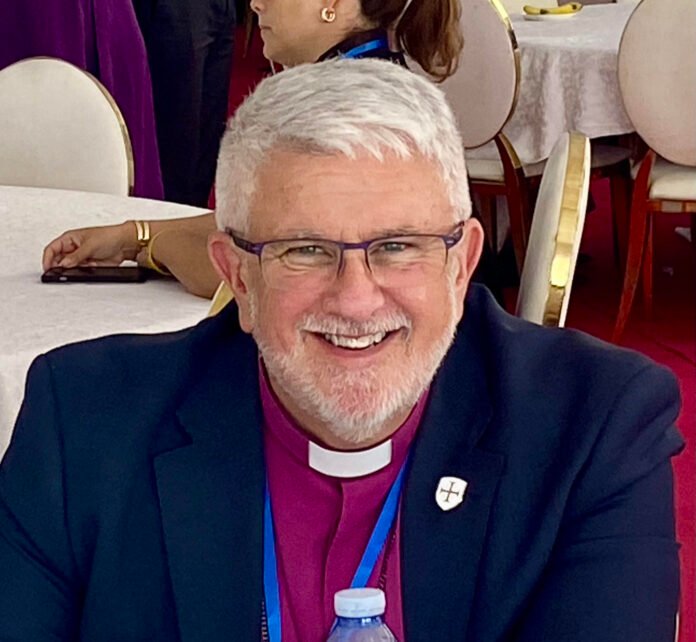
[ABUJA,NIGERIA] “Many Antichrists” now operate inside Anglican structures, the Rt Rev. Richard Condie, Bishop of Tasmania, told the G26 conference of Anglicans meeting in Abuja Nigeria on March 6, 2026, denying Christ and his word, and called delegates back to Scripture, the Spirit’s anointing, and persevering union with Jesus
Bishop Condie has warned that the Anglican Communion’s present turmoil is a sign of the church’s “last hour,” urging G26 delegates to stand firm against false teachers and to “remain in Jesus” with the same resolve Martin Luther showed at the Reformation. Preaching from 1 John 2:18–28, Condie argued that the appearance of “many Antichrists” within the visible church is not an accident of history but a biblical mark of the end times and a searching test of authentic discipleship.
Condie framed his Bible study with Luther’s 1521 appearance before the Holy Roman Emperor, when the Reformer refused to recant unless convinced by Holy Scripture and sound reason. Luther’s “Here I stand, I cannot do otherwise” became the lens through which Condie challenged bishops and clergy to choose whom they will serve amid today’s doctrinal and moral confusion, refusing to submit their consciences to ecclesial structures that have departed from apostolic truth.
Expounding John’s language about “the last hour” and “many Antichrists,” Condie stressed that the most unsettling feature of these opponents is that they arise from within. “They went out from us, but they did not really belong to us,” he said, quoting verse 19, and argued that it is the abandonment of apostolic faith and fellowship, not merely institutional separation, that reveals their true allegiance. He recalled J. I. Packer’s image of the Anglican Communion as a flotilla of provincial ships once sailing together until some suddenly veered off course in the early 2000s, with more drifting since. Those provinces that embrace revisionist teaching, he suggested, have “gone out from us” in Johannine terms.
At the heart of the crisis, Condie said, lies a denial of Christ himself. Pointing to John’s stark question, “Who is the liar? It is whoever denies that Jesus is the Christ,” he applied this to contemporary Anglican life: the issue is not minor disagreements but the erosion of core Christological truths such as the virgin birth, miracles, bodily resurrection, and the binding authority of Jesus’ own teaching. When “so‑called bishops” cast doubt on these essentials or reinterpret them beyond recognition, they function as Antichrists, denying the Father and the Son while still speaking church language.
Condie also warned of more subtle forms of denial at work in today’s church. He described Antichrists who promise prosperity instead of the costly path of the crucified Lord, who replace moral clarity with a “bland ethic of love” that demands no repentance, who entice leaders with power, status and ecclesial privilege rather than the humility of the Son of Man, and who domesticate Jesus into a therapeutic companion existing for our comfort. In a moment of self‑examination, he confessed how bishops can deny Christ when they seek honor, wield power without mercy, or accept money and prestige from false teachers while affirming orthodox statements at conferences.
Against this backdrop, Condie set out four commands from 1 John for those he repeatedly called “dear children”: know the truth, remain in the word, remain in the Spirit, and remain in Jesus. Believers, he said, have an “anointing from the Holy One” – the Holy Spirit – who enables them to discern truth from lies and to distinguish Christ from Antichrist, a work of God in the heart rather than mere intellectual achievement. He illustrated this with his own conversion as a teenager, when his heart was “strangely warmed” and he knew with clarity that Jesus is the risen Son of God.
To “remain in the word,” Condie insisted, is to cling to what we have heard “from the beginning” rather than chase theological novelty. True maturity, he argued, lies not in constant innovation but in being settled in the apostolic gospel. He echoed the Jerusalem Declaration’s call to read, preach, teach and obey Scripture in its plain and canonical sense, and repeated the charge given at his consecration: “A bishop without a Bible is no bishop at all,” urging that only those who love and are trained in Scripture be ordained, licensed and sent.
Remaining in the Spirit, he continued, means trusting the Spirit’s ongoing ministry as teacher and guide, in line with Jesus’ promise to lead his disciples into all truth. If the church has the word of God in its hand and the Spirit of God in its heart, Condie said, it has all it needs to grow in truth and holiness. But the climax of his exposition came in the call to remain in Jesus himself, the true vine without whom no branch can bear fruit. Remaining in Christ is, for Condie, the ultimate antidote to false teachers, the central focus of Anglican faithfulness, the source of every legitimate ministry, and the real reason for the G26 gathering.
Looking ahead to the return of Christ, Condie told delegates that “the day of his coming is nearer now than ever before. It is the last hour. The time is short.” On that day, he reminded them, Anglicans will not stand before synods, parliaments or secular courts, nor be identified as Global South or Global North, but will stand before the Lord Jesus Christ, the judge of heaven and earth. The decisive question then will be whether they are found remaining in him – not because of their own strength or cleverness, but because he has remained in them and held them fast.
“Today we choose again whom we will serve, where we will place our trust, where we will be found: remaining in the Lord Jesus, confident and unashamed before him at the day of his coming,” Condie concluded. “Here we stand, for we can do no other. The Lord be with you.”