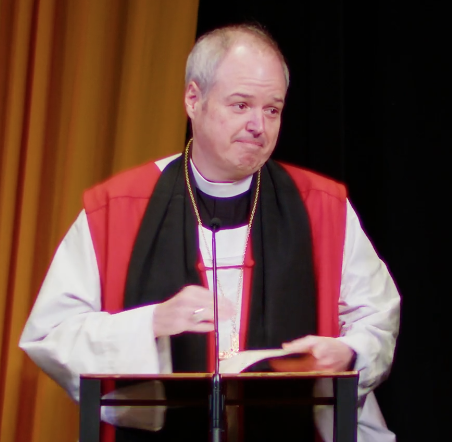
Following are opening remarks, as prepared for delivery, by Presiding Bishop Sean Rowe to the Executive Council of The Episcopal Church, which met virtually Feb. 20.
Good morning, and welcome to this meeting of Executive Council. As you know, we are meeting online this month in order to conserve our time and budget for a retreat in June, when we will visit the Diocese of Puerto Rico and do some intensive work on our strategic plan. Thank you for your flexibility and your willingness to make time for our important strategic work together this summer.
At today’s meeting, we will review the early work we have done on the strategic plan and in that context, hear some important updates from our chief financial officer and our chief legal officer about the context for ministry in these times and how we are adjusting.
We will also handle some routine business, including electing a new member. We have two new members with us here today, and before we begin our work, I want to welcome them: the Rev. Deacon Andrea Gardner of the Diocese of Pennsylvania, who joined us for our brief budget meeting in December, and the Rev. Mark Nabors, our new clergy representative from Province VII. Andrea is filling the unexpired term left by our beloved Stan Baker, who died in June, and Mark is filling the unexpired term left by the resignation of Shay Craig, who I will have the pleasure of ordaining as bishop of North Dakota in just a few weeks.
I also want to note and give thanks for the service of Heidi Kim as a member of Executive Council this triennium. Heidi, as you know, was named to be the first executive director of the Episcopal Coalition for Racial Equity and Justice last month, and I look forward to working with her as she takes up that new role. We will elect her replacement online between now and the June meeting so that we can have a full complement of members for that important retreat.
But first, we have Lent. Have you ever noticed that some years, Lent seems like a little bit out of context? Things are going along well, spring has come early, and a season of fasting and repentance seems sort of misplaced. “We’re good—no need for sacrifice here!”
Not this year. This year, we are squarely in Lent. Even the weather on Ash Wednesday, at least where I live, was just the kind of weather that you’d expect to begin a penitential season. Didn’t you feel it when you prayed the Litany of Penitence? False judgments? Check. Uncharitable thoughts toward our neighbors? Check. Prejudice and contempt toward those who differ from us? Check, check, check.
As I wrote in my Ash Wednesday letter to the church, these days, it can seem like we are living in a wasteland created by the forces that keep people trapped in violence and division, separated from one another and from God. Drawing on the story of the Exodus, I call this condition Pharaoh’s imagination, and these days, I think much of our world is captive to it.
Our vocation as Christians is to turn away from Pharaoh’s imagination toward God’s imagination. In the Bible, we are called again and again to understand the world as God sees it—as a place where divisions and hatred are overcome by God’s love, which makes all things new. In Paul’s second letter to the church in Corinth, which was deeply divided and distorted by personality cults, Paul writes, “From now on, therefore, we regard no one from a human point of view.” What he is saying is that when we humans lose our way and are ruled by anger and division, we need to see things in a different point of view—as Christ sees us, not as we humans see each other.
And even seeing each other differently is not the whole work of conversion. It’s easy to see Pharaoh in someone else. But the fact is, we all have a Pharaoh within. And in order to escape from that kind of limited imagination, you have to be willing to be unseated from your own certainty, from your own convictions about those other people—the ones you feel justified in hating, or being angry at, or looking down on.
The call to turn away from Pharaoh’s imagination toward God’s imagination is evergreen, but Lent gives us an excellent excuse to begin, or to begin anew. As we take up this Lenten discipline, I am mindful that as members of the church’s Executive Council, we carry an extra burden of responsibility. We are charged with remembering that all of the work we do—budgets, resolutions, elections and strategic plans—are how we organize the body of Christ to do the work of proclaiming the Gospel.
Our work as a board can seem mundane when the principalities and powers are raging around us. But committing ourselves to strong, strategic governance is how we build the institutional capacity to resist Pharaoh’s dystopia. We are doing this now in countless ways: by advocating for the priorities of General Convention with our elected officials, by stewarding our resources to see us through the lean years that are on the way, and by helping dioceses become sustainable and bear witness to the Gospel in their communities.
In recent months, the need for immigration ministry has been particularly active. Right now, your governance ministry is supporting us as we:
- Sue the government over immigration enforcement in churches and other sensitive locations and submit briefs on behalf of others who have brought legal action to protect religious liberty and the dignity of immigrants.
- Move quickly to carry out Katie Sherrod’s inspired plea at the December meeting for emergency grants to dioceses dealing with immigration enforcement crises.
- Triple our church spending on Episcopal Migration Ministries staff who function as a rapid response team in places where there are immigration crises around the church.
- Help Episcopalians send tens of thousands of messages to their elected representatives in Congress on immigration policy.
- Host vigils, trainings, and preparedness webinars for thousands of Episcopalians; and offer significant behind-the-scenes support for our bishops and leaders on the ground.
All of these actions, and many others now underway, are how we carry out Jesus’ command to love our neighbor as ourselves. What Jesus is telling us in that commandment is that we are all part of one body. There is no difference between us and our neighbor. And because we are one body, when we hate and revile each other, we are only destroying ourselves. When we embrace the understanding that we are all bound up together in one body—in “a single garment of destiny,” as the Rev. Martin Luther King Jr. said—we can truly liberate ourselves from Pharaoh’s imagination.
As we lead The Episcopal Church in this tumultuous time, I pray that we can hold fast to the promise that the conversion of our hearts in Lent will lead us, at last, to the empty tomb and the joy of the Resurrection.