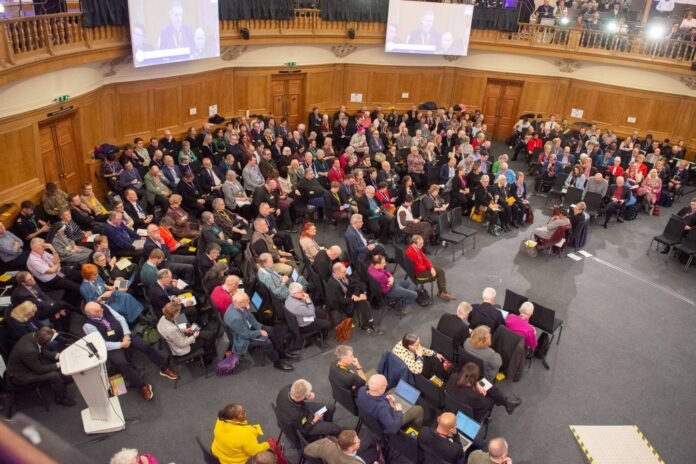
I am writing this piece in Church House, the morning after a five-hour debate on Living in Love and Faith (LLF). As with many lengthy debates, the interpretation of what was agreed and what happens next can be unclear. The public understanding and the reporting by the press has not been helped by the Church House Comms team not having any prepared statement ready in the aftermath of the debate explaining the context and nuance of what happened; one has now been issued. As a result of this void, some of the headlines, such as the BBC’s “Church of England abandons proposals for same-sex blessing ceremonies”, were eye-catchingly negative but also quite wrong. As someone who was in the chamber for the debate, and involved in much of the discussions behind the scenes leading up to it, I offer this to help understand what really happened.
The House of Bishops had brought forward a motion that did four things. First, there was an apology for all the distress and pain caused during the LLF process, especially to LGBTQIA+ people. Next was a statement that LLF would draw to a close, although I will unpack what that means later. Third was thanks to all those involved in the work of the LLF process. Finally, and most substantially, Synod was asked to commend the House of Bishops’ proposal for what would happen next.
The Archbishop of York, in presenting the motion, stated how this was a way forward around which the House of Bishops could cohere. That would be important as many of the areas of further work, particularly around clergy equal marriage and standalone services of blessing using the Prayers of Love and Faith, would need the House of Bishops to get behind them if they were to progress.
For the first clause, the apology, there were several amendments seeking either to strengthen this or to change its focus. The move to strengthen the apology came from Charlie Baczyk-Bell, who in a powerful and emotional speech expressed a direct call from LGBTQIA+ people underlining the failings so far of LLF and the need to acknowledge the ongoing damage to LGBTQIA+ people. While none of the amendments regarding the apology passed, it was encouraging that there were bishops who were moved to vote in favour of strengthening the apology. I know from speaking with some bishops in Church House that the apology offered in the motion is genuine.
The second clause was a change of methodology, but not of direction. It effectively said that the grand project known as LLF, begun in 2017, would draw to a close. It was not saying that the underlying issues had gone away, nor that no further work would be done, something that only became clear in the final clause. Living in Love and Faith had sought to address LGBTQIA+ inclusion, the measures that could be passed to advance it and the provision necessary for those of a traditional outlook as a result. This has made the process rather heavy and cumbersome, with forward movement in one area stalling because of work in others not being ready. In trying to deliver a whole package of measures together, LLF has buckled under its own weight. This clause in the motion is not, as the press have inaccurately claimed, the end of work towards inclusion. Rather it acknowledges that LLF has run its course, that some measures have passed and others will be taken forward through different, more focussed routes. This has the advantage that some of the most controversial ideas on provision for those opposed to inclusive change are not baked into proposals. The Bishop of Chelmsford spoke in the debate to make clear that it was these divisive measures, such as Delegated Episcopal Ministry, which had made the full package approach of LLF unacceptable to the Bishops, and that future plans would not be dependent on such major structural changes that would undermine our ecclesiology.
We should not forget that, through LLF, since 2023 we have had commended liturgy of blessing those in a committed same-sex relationship for use in regular services. Some would argue that this liturgy is also available for clergy to use in other contexts under canon law. Following a Private Member’s Motion to Synod, there has also been the withdrawal of the controversial Issues in Human Sexuality document as pastoral guidelines to which clergy have to sign up, something on which the Together on General Synod group led the way in July 2025.
The third clause thanking members of working groups for their work was uncontroversial, the fourth – detailing the way ahead – being the main point of substance. Before this debate, the point we had reached was there are two outstanding items of business. The first is equal clergy marriage: those in a same-sex marriage currently cannot receive a licence to minister or go into the vocations, training and ordination process. The second concerns questions around the full use of the Prayers of Love and Faith, in particular whether they could be used in “standalone” services.
The proposal from the Bishops was to continue that work under a newly-formed group. When papers for Synod first came out, many pushed back at this, seeing it as yet another working group, meaning yet more delay. However, there is a subtle difference this time around, as the group will be more focussed on specific issues and tasked with bringing proposals back to the House of Bishops on how to get things done. The papers before Synod had already outlined some options, such as making amendments to the Canons to allows clergy to marry freely. Those of us advocating for inclusive change recognise that the Bishops want to do this with substantial due process, giving any changes the most secure legislative underpinning as possible. If this can be achieved, then the accompanying inclusive change will stand on secure foundations.
The fact is that, if we want to definitively allow clergy equal marriage, we will require change to the canons. That in turn requires a working group that can evaluate the options, draw up papers and recommend how it could be done. There will then need to be a body, in this case the House of Bishops, to sponsor that change to the canons and present it to General Synod. And then General Synod will need to go through the legal process to ensure the legislation is sound, well drafted and enacts the policy that Synod is wanting to see. That may sound lengthy and laborious, and it will be, but it is also how deep, enduring change is best constructed and embedded into our common life.
After five hours of debate, we reached a point where all amendments brought were rejected (some by greater margins than others) and we voted on the original motion as brought by the House of Bishops.
Inclusive members within the Chamber had a choice. We could vote for the motion, and for the journey towards greater inclusion to continue. We could abstain, explaining separately the rationale behind this choice. Or we could vote against and completely undermine any pathway towards deliverable outcomes. That could mean the cessation not only of the LLF process but of any future work on LGBTQIA+ inclusion, for years to come.
We came into Synod with many on the inclusive side being very uncomfortable in voting for the motion. Over the week, the choice became clearer that we either supported the Bishops in continuing work, or we came alongside conservative voices who wanted it to stop altogether. The key factor in the inclusive group swinging heavily behind work continuing was testimony from LGBTQIA+ members, particularly clergy, that while this had been deeply painful for them they wanted us to keep going. Some courageous and heartfelt speeches from Claire Robson, Rachel Mann, Matt Edwards and others were profoundly moving; do watch them on the Church House YouTube record if you can. I continue to be in awe of the patience and faithfulness of LGBTQIA+ Christians who have every reason to turn their back on the Church, yet persist in solidarity with each other and keep following Christ despite the hostility and pain they are often shown. Speaking as a straight ally, they are an inspiration to me.
The final motion was passed with 65.6% in favour, indicating a strong mandate for the work to continue. There have been four major LLF debates so far (February 23, November 23, July 24 and this one), and this margin of support is the largest we have seen yet. What needs to happen now is for the House of Bishops, who supported the motion with none voting against, to own this and drive it forward. We have learnt much through LLF, but we need to take that learning and translate it into action. Then it will be for the General Synod to take recommendations and pass them, so that more barriers to full inclusion can be dismantled.
It will not however be this set of General Synod members who will make those decisions, because there is a General Synod election in late summer this year. Those who long for inclusive change, and hear the call from our faithful LGBTQIA+ Synod members to keep going, need to organise for those elections. Together for the Church of England and Inclusive Church are in partnership on this; do follow us on social media, subscribe to our newsletters and check our websites for more ways to do this. Together has diocesan networks across the church who are organising for the elections. More information on what will be happening and how you can make a difference will be released over coming weeks and months. If we can extend the inclusive membership in Synod, which is already substantial, then the work guaranteed by this most recent vote on LLF will be able to deliver so much more. A more inclusive, diverse and compassionate church is possible, and the way to achieve it is clear. The question is whether the broad inclusive majority in the church can step up and seize the moment.
Nic Tall is the National Co-ordinator of Together for the Church of England