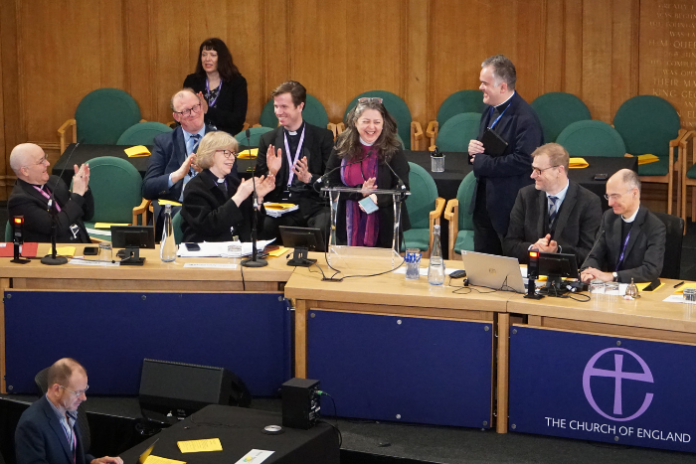
The Primate of Brazil, the Most Revd Marinez Rosa Dos Santos Bassotto, addressed the Church of England’s General Synod this week about environmental justice and her experiences of COP30. She spoke during a session that the Synod designated for addresses by Anglican Communion guests.
Speaking on Friday 13, Archbishop Marinez spoke of her passion for the environment and the central role churches can play in advocacy. As the Primate of Brazil and the bishop of the Amazon, she is a campaigner for international and national protection of the environment. She was a key spokesperson at COP30 last year, and the Anglican Communion’s ‘Lungs of the Earth’ initiative that was launched in 2025. It calls people to ‘restore and protect vital ecosystems of oceans, forests and ice landscapes.
Read a transcript of Archbishop Marinez’s address (Transcript is translated from the address given in Portuguese):
I am grateful for the opportunity to share with you at this Synod about the Province of Brazil, the Anglican Diocese of the Amazon, and COP 30 held in the Amazon, where I live. The Church of Brazil has been in existence for 136 years. We are present throughout Brazil and have nine dioceses and one missionary diocese. Although we are a small Church, we are a Church in missionary expansion. The Anglican Diocese of the Amazon is the Diocese with the largest territorial extension in the Church of Brazil, covering more than 42% of the Brazilian national territory. There are five states in the Brazilian Amazon region.
The mission is quite challenging, the dioceses are enormous, and the journeys to reach distant communities are very long. We are strongly involved in the area of socio-environmental justice. One of our missions is to amplify voices and walk alongside those who fight to stop the destruction of the forest and the contamination of water and land. We support climate resilience actions, promote solidarity economy initiatives, native tree reforestation projects, and numerous advocacy actions.
I would like to share a little about COP 30, which took place in November last year in Belém do Pará, the city where I live. The most encouraging decisions of COP 30 were the approval of the goal to triple funding for climate adaptation, aiming to protect populations vulnerable to climate impacts, and the creation of the Tropical Forest Fund. On the other hand, there were frustrations and criticism regarding the lack of a definitive plan for a just energy transition and the abandonment of fossil fuels.
In terms of negotiations and decision-making, COP 30 did not make significant progress. On the other hand, we can say that the Amazon COP was the largest in terms of popular participation. The Climate March brought together 70,000 people. The People’s Summit, a conference that took place simultaneously with COP, brought together more than 70,000 participants to discuss climate solutions based on the experiences of indigenous peoples, traditional communities, and social movements.
The Ecumenical and Interreligious Tapiri, also held in parallel, was a major gathering attended by more than 60 Christian denominations, non-Christian religious traditions, and faith-based organisations from around the world. It brought together more than 15,000 people in our Anglican Cathedral, and was a space for dialogue, forming alliances and drafting proposals. Proving that churches can promote meaningful dialogue and action related to socio-environmental justice.
Churches can and should be a prophetic voice, denouncing environmental and social injustices, defending the rights of vulnerable peoples, and calling for urgent action to protect God’s creation. We are in a position to mobilise and engage our congregations in concrete actions in defence of the environment and socio-environmental justice, such as awareness campaigns, reforestation projects and the promotion of sustainable practices. We can act as bridges between different actors, promoting ecumenical and interfaith dialogue, bringing together representatives of governments, businesses, civil society and local communities to find joint solutions to environmental and social challenges. We can also offer spiritual and pastoral support to people affected by climate change and environmental degradation, promoting healing, reconciliation and hope.
I firmly believe in the leading role of the Churches of the Anglican Communion in addressing the climate crisis. We cannot be mere observers; we must be agents of change. This means acting as bridges, facilitating dialogue and the search for solutions that respect both the environment and human dignity.
We need to mobilise our faith communities, inspiring them to become active defenders of God’s creation, our Common Home, and to take concrete actions for environmental protection and social justice. This commitment should not be merely a theoretical guideline, but a daily experience, rooted in our faith and shaped by the reality in which we live. The time is now, the moment is this.