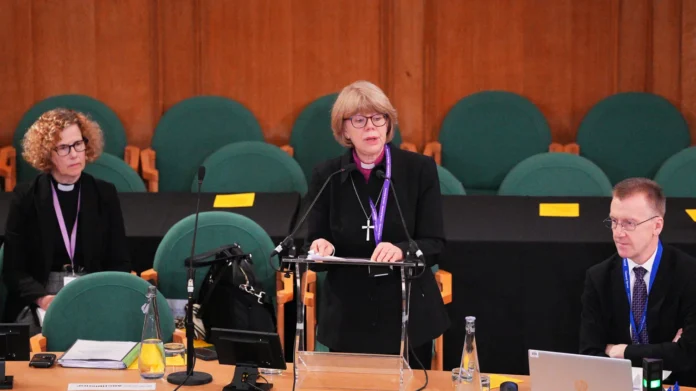
The Church of England has fallen “tragically short” in protecting people from abuse, but must now strive to be a “stable presence in an unstable world”, the new Archbishop of Canterbury has said in her first speech.
Referring to the “volatility of global politics”, the climate crisis, the “challenges of inequality and injustice” as well as the turmoil within the church, the Most Rev Dame Sarah Mullally said that “hope is a muscle that we must build and develop”.
She also said that the church must submit to “independent scrutiny of our safeguarding practices” after lawyers and survivors have repeatedly criticised the church for allowing bishops to rule on disciplinary complaints against each other.
Giving her first address as archbishop to the church’s national assembly, the General Synod, at a meeting in London, Mullally said it was a “humbling privilege to be called to serve in this role”. She is the 106th and first female Archbishop of Canterbury.
There were whoops and applause when she stood up and read out her official synod membership number and new title for the first time — as is customary at the start of synod speeches — declaring: “Sarah Mullally, 001, Canterbury.”
Mullally said at Church House in Westminster: “When the wind and the waves are rocking the boat, I am reminded that what I need to do is focus on Christ, who calms the waters and stills the wind.”
She said she had been “overwhelmed by the encouragement, prayers and support that I have received from countless people” and highlighted early signs that the recovery in attendances since the slump of the pandemic had continued into 2025.
Referring to a comment made by the Archbishop of York, the Most Rev Stephen Cottrell, during her confirmation of election service at St Paul’s last month, she joked: “You said: ‘Just be yourself.’ You may find that in the years to come you may regret that advice – but we will cross that bridge when we come to it!”
Mullally said of the church: “We have too often failed to recognise or take seriously the abuse of power … Nowhere is accountability more imperative than in relation to safeguarding, where in the past we have fallen tragically short. Safeguarding is a fundamental, non-negotiable responsibility, sharpened by our past failings and shaped by the work we still have to do.”
In her concluding remarks, she added: “The role of the Archbishop of Canterbury is a complex and challenging one. …” Read it all at The Times