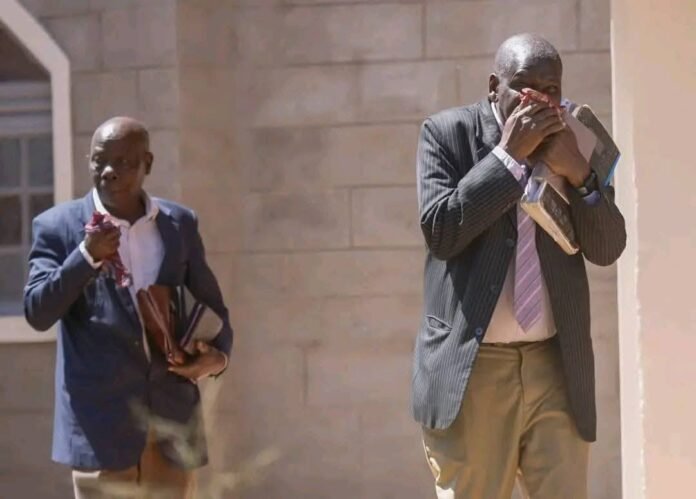
An attack on members of the congregation of St Peter’s Witima Anglican Church of Kenya (ACK) in Nyeri County last Sunday by plain clothes policemen who fired tear gas grenades into the church during worship, has outraged church leaders in the East African nation, who describe it as a direct assault on freedom of worship by the government.
At the Sunday 25 January 2026 service of Holy Communion at St Peter’s ACK Witima in Othaya, Nyeri County, chaos erupted when men believed to include police officers and hired thugs stormed the church compound, lobbed tear gas, and caused parishioners to flee in panic. Among those attending the service were former Deputy President Rigathi Gachagua and several opposition‑aligned politicians. Video and eyewitness accounts show gas grenades fired in and around the sanctuary itself, leaving worshippers – including women, children, and the elderly – gasping for air and scrambling for safety. Vehicles within the compound were damaged and the service brought to an end.
The Kenya Human Rights Commission responded with a statement saying the officers’ actions violated an existing High Court order that explicitly forbids the use of live ammunition, tear gas, or other crowd‑control agents against people in places of worship and other protected spaces. The incident quickly moved from a local disturbance to a national controversy, as Kenyans debated whether the attack was a targeted move against Gachagua and his allies or part of a broader pattern of state heavy‑handedness toward opposition‑linked gatherings.
Anglican leaders in Kenya have framed the Witima affair as a spiritual crisis – an attack on the holiness of the church – and secondarily as a political or security issue. The Most Rev. Jackson Ole Sapit, primate of the ACK, said the attack “desecrated” a place that should be a sanctuary of peace, prayer, and reconciliation. He stressed that churches must remain safe havens where Christians may gather “without fear,” and warned that normalising violence in sacred spaces would gravely wound Kenya’s moral fabric.
The United Clergy Alliance issued a statement calling the Witima incident a “grave violation of the sanctity of places of worship and a threat to Kenya’s constitutional and spiritual order.” Bishop Joel Nzomo, the Alliance’s Secretary General, insisted that “the Church is God’s sanctuary and must be treated with reverence, order, and holiness,” declaring that “any form of violence, disorder, or forceful intrusion within a place of worship amounts to desecration of sacred ground.” The Alliance demanded that the National Police Service cease conducting security operations within church compounds and issue an unequivocal apology for what it termed “sacrilege and transgressions witnessed last Sunday.”
The National Council of Churches of Kenya (NCCK) condemned the use of force at Witima and described it as a direct violation of freedom of worship. NCCK called for the immediate interdiction, investigation, and prosecution of the officers involved, and demanded public apologies from the Cabinet Secretary for Interior and the Inspector General of Police.
The Kenya Human Rights Commission, echoing the churches, argued that Witima is not an isolated case but part of an “escalating pattern of police violence” and a worrying disregard for court orders designed to protect civilians in vulnerable spaces, including churches. KHRC called for accountability not only for the officers on the ground but also on the basis of “command responsibility,” targeting those who “knew, or should have known” of the violations and failed to prevent them. Kenyan commentators in the secular press have likewise referred to Witima as “deeply troubling,” stressing that worshippers appear to have been attacked primarily because of the presence of certain politicians, rather than any credible security threat.
The Witima affair cannot be separated from Kenya’s tense political climate in the run‑up to the 2027 general elections. Former Deputy President Rigathi Gachagua has become a prominent critic and rival within Kenya’s shifting political alliances, and his public appearances – especially in his home region of Nyeri and the wider Mount Kenya area – now attract both fervent support and organised hostility. Churches, particularly ACK congregations in Central Kenya, have long been preferred venues for politicians to address crowds, blurring at times the line between worship and campaign rally and making parishes de facto battlegrounds for competing factions.
Witima has emerged as a flashpoint in a broader struggle over who controls the Mount Kenya political narrative and how far the state is prepared to go in containing dissent. Some security officials have suggested that investigations are ongoing and that no injuries were officially recorded, but this has done little to calm public anger over images of worshippers choking on tear gas inside a church. The incident also revives long‑standing Kenyan fears about partisan policing, excessive force at public gatherings, and the chronic failure to punish officers implicated in abuses. Church leaders warn that, if left unchecked, such incidents will discourage attendance, erode trust in both the state and ecclesial institutions, and fracture national cohesion along political and regional lines.
In the wake of the Witima affair Kenya’s Anglican bishops have drawn a clear line: whatever the nation’s political quarrels, the church is not a battlefield.