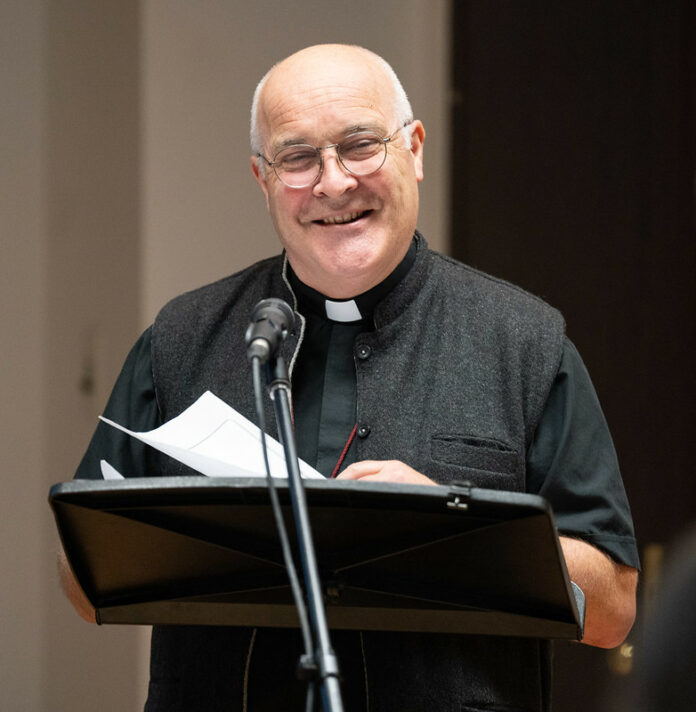
Archbishop Stephen article as published in To Vima special supplement edition. This edition includes many contributions reflecting on the 1700th anniversary of the first ecumenical council held in Nicaea
It is a great joy to send my greetings to all who will participate in the celebrations to mark the 1700th anniversary of the First Ecumenical Council, held in Nicaea in 325. I am delighted that my friend and colleague Bishop Anthony Poggo, Secretary General of the Anglican Communion, will be present with His All Holiness Bartholomew, Ecumenical Patriarch of Constantinople, His Holiness Pope Leo XIV, and other Christian bishops and church leaders at this joyful occasion. The Council marked a vital moment in the history of the Christian Church, both for what it was, a gathering of bishops to guide the church, and what it produced, in terms of canonical laws and above all the statement of faith that is known as the Nicene Creed.
The Creed of Nicaea has a special place in three areas of the life of the Anglican Communion and particularly in the life of the Church of England, where I minister. Firstly, it is part of our liturgy. At every principal celebration of the Holy Eucharist, the creed is recited by the whole congregation after the proclamation of the gospel and the homily. In some circumstances a shorter form of the creed may be used, but the most frequently used, and the most well-known, is the Nicene Creed. Many learned the words as children long before they understood their meaning. They are almost as familiar as the words of the Lord’s Prayer.
Secondly, the Nicene Creed is integral to our understanding of the Church, and to our place in the worldwide Church across the ages. We recognise it as an essential sign of the Christian faith that we have received and which we teach. In the Church of England, whenever a bishop, priest, deacon or lay minister enters into a new ministry, the bishop requires them to make certain promises, first saying,
“The Church of England is part of the One, Holy, Catholic and Apostolic Church worshipping the one true God, Father, Son and Holy Spirit. It professes the faith uniquely revealed in the Holy Scriptures and set forth in the catholic creeds, which faith the Church is called upon to proclaim afresh in each generation.”
Thirdly, the Nicene Creed is part of the basis on which we build ecumenical relationships. Since 1867, Anglican bishops from around the world have met every ten years or so to take counsel in the Lambeth Conference. In 1888, the bishops addressed the question of what would be necessary to move towards bringing separated churches together towards unity. They decided that four articles would supply a basis: the Holy Scriptures of the Old and New Testaments; the Apostles’ Creed, as the baptismal symbol, and the Nicene Creed, as the sufficient statement of the Christian faith; the sacraments of Baptism and the Holy Eucharist; and the historic episcopate. As the Bishops at the Council of Nicaea intended, the Nicene Creed remains the full statement of the Christian faith for Anglican Christians.
With my fellow Anglicans across the world, I give thanks for the guidance of the Holy Spirit that so inspired our forebears in the faith, and I pray that we may continue to celebrate, proclaim and teach what we have received from them.