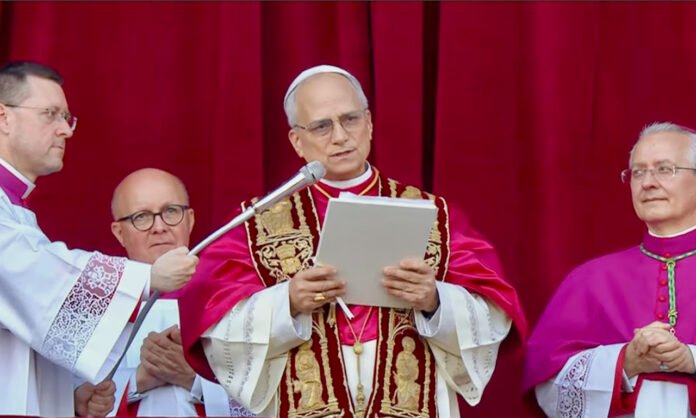
Leo XIV treats Anglican orders as genuine, although Leo XIII called them fake.
Would you pretend something is authentic when you know it is counterfeit?
As a lad studying the violin under the virtuoso Melbourne Halloween, I was chastened for failing to distinguish between a fake and a real Stradivarius. Antonio Stradivari was an Italian luthier renowned for crafting the world’s finest violins. His most expensive violin sold for $20 million in 2022.
I grew up thinking that my father owned a Stradivarius. He used to keep his expensive violin locked and gave me a cheaper violin. One day, through the F-holes in my father’s violin, I read the label stuck inside the chamber. It said Stradivarius. I was ecstatic. I proudly told Halloween that my father owned a Stradivarius. He smiled.
A week later, my dad allowed me to take his violin to the lesson. Halloween played it sublimely. I asked him how much it was worth. After all, it was a Stradivarius! Amused at my naïveté, he told me it wasn’t a real Stradivarius. He explained that it was not uncommon for violin makers to stick the Stradivarius label on their creations. It simply meant that the instruments they made were copies of a real Stradivarius. I never again told anyone that my dad owned a Stradivarius.
I couldn’t pretend something is authentic when I knew it to be an imitation.
Catholic Priests Are Stradivarii — Protestant Pastors Are Fakes
For centuries, Catholics have been told that their priests are Stradivarius violins. Why? Because they have “apostolic succession” that goes back to Jesus and the apostles. The Council of Trent infallibly claims that “this priesthood was instituted by the same Lord our Saviour.” Except for Eastern Orthodox priests (who may be grudgingly classified as low-grade Stradivarii), Rome designates ministers of other churches as bootleg priests.
Most Protestant churches couldn’t give a hoot about Rome’s cock-a-doodle-do. Apostolic succession is vital for them, but they understand apostolic succession as the continuity of apostolic teaching and not as the tactile transmission of a bishop laying his white-gloved hands on the vaseline-manicured scalp of an ordinand (who is ontologically transformed by this episcopal alchemy).
Rome has a particular problem with Anglicans, who assert that their priests are also Stradivarii because they retained apostolic succession. But Pope Leo XIII’s bull Apostolicae Curae (1896) trashed Anglican orders as “absolutely null and utterly void.” He stipulated that his bull “shall be always valid and in force and shall be inviolably observed both juridically and otherwise….”
While Leo XIII ruled that Anglican bishops and priests are laypersons cosplaying as clergy with their cassocks, chasubles, and croziers, Leo XIV seems to believe that Anglican bishops and priests are the real thing. He took the extraordinary step of hosting King Charles III, the Supreme Governor of the Church of England, and the Anglican Archbishop of York, Stephen Cottrell, for a joint prayer service in the Sistine Chapel on October 23.
Leo Welcomes Archbishop of Canterbury on Equal Terms
Leo didn’t treat Charles and Cottrell as fakes. He welcomed them with full honours according to their respective ecclesiastical roles. He didn’t address Cottrell as “Mister” but as the “Most Reverend.” Cottrell was decked out in full clerical vestments for the service. He stood alongside Leo on an equal footing. The Anglican-styled service was in Elizabethan English. Thomas Tallis’ anthem If ye love me was the high point of the service. I felt I was back leading Evensong in my Anglican cathedral. Leo and Cottrell led the service together antiphonally and gave the benediction together in unison.
Even more significantly, Leo bestowed on Charles the spiritual title of the Royal Confrater of the papal basilica of St. Paul’s Outside the Walls. Leo even ordered a special chair to be permanently installed in the basilica for Charles and his successors. The “throne” will bear King Charles’s coat of arms and the Latin inscription Ut unum sint, which, not insignificantly, is the title of Pope John Paul II’s encyclical on ecumenism. In turn, with the approval of King Charles, the [Anglican] Dean and Canons of the College of St George Windsor bestowed the title of Papal Confrater of St George’s Chapel, Windsor, on Leo. The pope accepted the honour. Bob and Charlie are now (confraternity) brothers.
Archbishop Carlo Maria Viganò, now excommunicated, tore his robes like Caiphas the high priest, asking how it was possible for the pope to commune with “lay heretics dressed up as prelates.” Traditionalist cardinals Raymond Burke and Robert Sarah, now domesticated, sat quietly like Peter warming himself by the fire.
Popesplainers might argue that Leo, at best, is demonstrating politeness as one might expect from a good host. At worst, he is humouring the Anglican pretence/delusion that their orders are valid. But these arguments ring hollow. First, Leo doesn’t have to stage a prayer service for Charles. He can host him according to Vatican protocol for receiving heads of state. Second, if Leo is pandering to an Anglican delusion, he is being staggeringly dishonest. He’s signalling to the world that a rip-off Stradivarius is the equivalent of a genuine Stradivarius.
So why are Leo XIII and Leo XIV marching in opposite directions? Like all pontiffs, Leo is a pope of his times. For centuries, Rome had disparaged Anglicans as heretics, schismatics, and apostates—the illegitimate children of King Henry VIII. Then, at the Second Vatican Council, God changed his mind. Rome waved the magic wand of its magisterium, and Bob’s your uncle, Anglicans now legitimate children.
In obedience to Rome’s decrees, God was compelled to adopt Anglicans (and other Protestants) as His foster children. Still, they were “separated brethren,” mongrels belonging to “ecclesial communities” (a rather torturous tautology, as if to say the “church,” which in Greek is ecclesia, i.e., community, isn’t an “ecclesial community”).
Pope Leo’s Bull: A Canon Without Ammo
Suddenly, the popes began schmoozing with the archbishops of Canterbury like teenage boys who have just discovered girls. John XXIII was the first to pop open a prosecco for Archbishop Geoffrey Fisher in 1960. In 1966, Paul VI took Archbishop Michael Ramsey’s right hand and placed his diamond episcopal ring on the Anglican prelate’s finger.
Since then, popes have been bestowing gifts freighted with symbolic weight on the archbishops of Canterbury. John Paul II gave a pectoral cross to Archbishop Rowan Williams on the occasion of his enthronement.
John Paul II gave Archbishop George Carey a copy of the Codex Vaticanus New Testament. Francis presented a crozier to Archbishop Justin Welby, which was a replica of St. Gregory the Great’s staff (the same Gregory who sent St Augustine to England as the first archbishop of Canterbury).
These gifts go beyond tokens of diplomacy; they are semiotically subversive and performative speech acts (J.L. Austin). First, their purpose is to acknowledge publicly the archbishops of Canterbury as valid bishops. Second, they are cleverly calibrated to defenestrate Apostolicae Curae. The “guerrilla theatre” (Amos Wilder) of the recent popes has been wildly successful. Leo XIII’s bull is now like a cannon without balls. Traditionalist Catholics who want to turn the clock back may fire it with gunpowder, but they can only make loud bangs without balls to demolish the target.
Read it all at The Stream