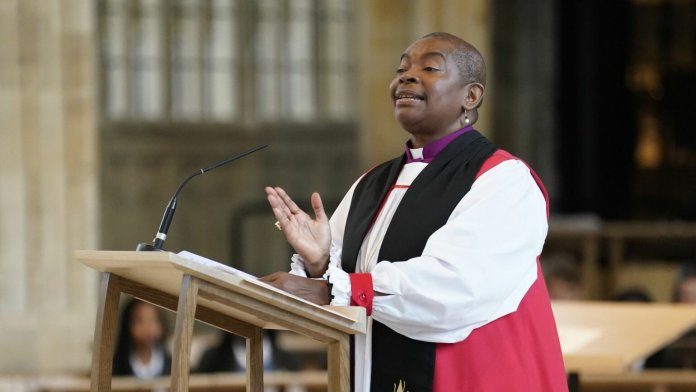
The Canterbury Graffiti Debacle
The Canterbury graffiti debacle is still rumbling on. When I woke this morning I found my earlier article here had been quoted by another news outlet. There’s always that moment if you wait to discover whether or not, they’ve quoted you accurately and sympathetically, or something rather worse. Luckily, on this occasion, it was accurate and sympathetic, and I was grateful; it doesn’t always happen. It reminded me how difficult it is to get a fair hearing from the mainstream media.
Obviously, what Elon Musk has done through X is indescribably important and something for which we can all be eternally grateful. But Substack is highly significant as well, and part of the purpose of writing this reflective essay is to thank you for your support and explain, at least from my point of view, with a rather more personal touch than usual, why it matters so much.
A few days ago, BBC Radio 4 phoned me and asked me to join in a public debate about the graffiti. For most of the last few decades, I would have been delighted to have the platform of Radio 4 on the BBC. It’s the serious channel where things get taken up, and you get listened to by the movers, shakers, and lawmakers. But things have seriously changed.
I was billed to be in discussion with a gifted Anglican priest who worked full-time as a psychiatrist and was just a priest at the weekend. He was a well-known “alphabet activist.” A clever man. Worth debating, but not to be underestimated.
The interview with the editor, in preparation for going live on the debate, took about an hour. I was pressed hard on my views, which is fine by me. I don’t mind articulating them, and I’m always pleased to have them represented properly.
But then alarm bells began to ring. I was suddenly asked what I thought about JD Vance and Elon Musk weighing in on the discussion. That wasn’t so bad. It was when they brought in Tommy Robinson that I realised things had changed — and were about to change a great deal for the worse. It’s true that Tommy Robinson had a tweet commenting on it, but along with literally millions of other people. Why should they quote him? Why should he suddenly be introduced into the conversation?
And ‘worse’ happened quite quickly. I was suddenly asked my views on “white supremacy.”
How on earth we’d got from an incompetent, alphabet-driven Dean commissioning trans-activist graffiti artists to vandalise one of the most beautiful buildings in the world, to white supremacy, wasn’t clear to me. But I quickly realised what traps were going to be set.
I was very happy — in fact, I was glad to have the platform to talk about beauty, truth, art, and God, and the relationship of Catholicism to all of them. But I realised I was about to be smeared with a whole load of other culturally immoral labels — ending up, if I was lucky, with “white supremacist.”
I decided to pull out of the programme. I think it’s the first time I’ve ever done something like that, and I wondered whether it was the right, courageous, and sensible action. As you can imagine, I listened to the programme with interest when they replaced me.
In fact, they replaced me with someone far more articulate — a historian and author called Bijan Omrani.
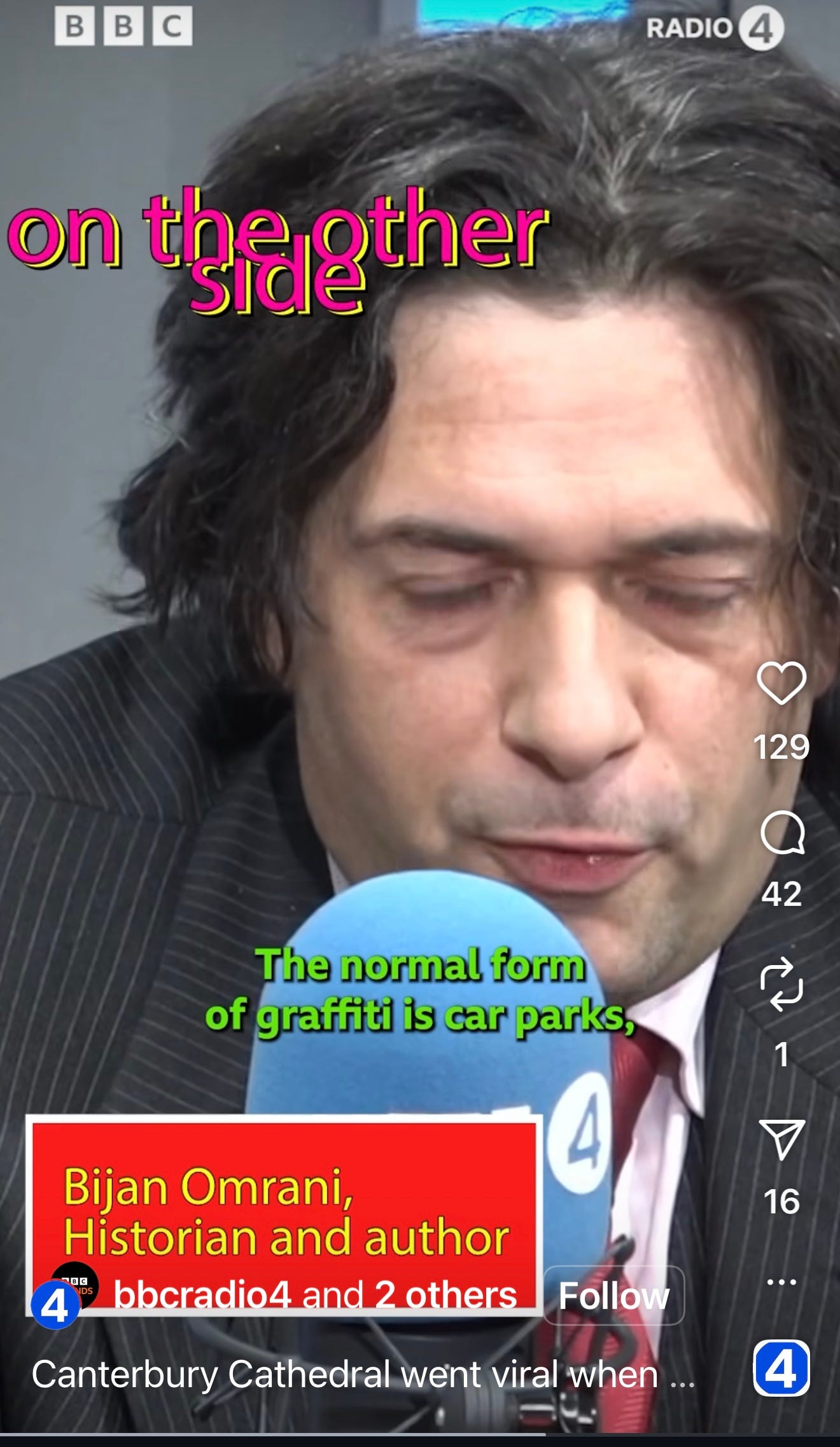
He’s not entirely white, and he’s an immigrant, so he picked up a few progressive “kudos points” that I would have completely lacked. Of my qualifications for doing this, I write and think about the subject — but I also happened to grow up around the cathedral.
As a boy, I was sent to school there. The cathedral stands at the centre of it — or rather, the school was built around the cathedral. The school’s been there since 597. It began as a place for training monks and carried on that way for a thousand years, until the Reformation.
I was cheering him on as I listened from the sidelines, wondering how they’d try to trap him — since they couldn’t do it with “white supremacy.” The trap came soon enough. Charlie Bell played the alphabet trump card — the one they always play, and for which there’s no really safe answer.
He spoke about the value of representing the marginalised and the dispossessed, since the artist was a trans activist. Then he accused Bijan of being part of a bourgeois hetero “aesthetic response,” the effect of which, he said, was to kill gay people — because if you increase their marginalisation, if you reject their claim to impose their agenda on society and exclude anyone who doesn’t agree, the effect is that “they commit suicide,” we are told. Your views make you a murderer, is the implication.
Undoubtedly, alphabet and trans people take their own lives in the same tragic way that straight people do — but it’s a correlation–causation issue. There’s no evidence that the beliefs of a heterodox society are directly responsible for people who don’t fit in killing themselves. But that’s the accusation.
Because there’s no evidence, you can’t refute it — and if you can’t refute it, they’ve got you. You’re a killer.
The First Trap
The first time I was trapped this way was about ten years ago, when I was being interviewed by the World Service in a debate with a woman who’s now the Anglican Bishop of Dover — Rose Hudson-Wilkin.
She’s a formidable debater. I was once a delegate at the World Council of Churches — about twenty-five years ago, maybe longer — and she gave a speech that inflamed all the Nordic Protestant feminists into a kind of collective outrage. The result was that the entire Eastern Orthodox contingent of the Council walked out in protest. She’s no amateur. And that was the first and unforgettable time when I was called a mass murderer for driving a countless number of gay African men to their suicidal deaths because of my oppressive white, Christian, heterosexual exclusive views.
I can hold my own — if they play fair. But they didn’t play fair. I thought I’d won the debate, but when it was published a week or so later, the BBC World service editors had cut and spliced the whole thing, disjointing the conversation and recreating it so that some of my serious questions were missing, and some of my answers were dropped into the wrong places.
It was an extraordinary exercise in disinformation and censorship, and I realised I’d been completely trapped. It’s one thing to enter a debate with an opponent and believe your arguments will be heard for their merits, even if the presenter is against you — which they often are. It’s another thing entirely to have the editorial team cut and splice it into a completely different conversation, in which you inevitably lose.
Losing Trust
It was that experience that made me wary of the BBC — although, as far as I was concerned, they already had ‘previous’.
Back When I Was Inside
Let me take you back to a time when I was a BBC presenter. Astonishingly, I was given my own show on the BBC local radio network. The area covered most of southeast England, including parts of London, and it had a huge reach. I kept the programme for four years, and the numbers grew exponentially. Some very powerful and wonderful things happened.
Let me give you an example.
The Interview That Changed Everything
I was given a woman to interview who had been the victim of one of the most appalling crimes imaginable. She’d fallen out with her lover, who had barricaded her with duckboards in a bath and poured petrol over her and set light to her, intending to kill her. He botched the job and went to prison for life, but she was left horrendously disfigured.
She became a Christian, though — and one of the most extraordinary parts of her story was that she’d come out publicly to forgive her murderous ex-lover. I was to interview her about how one forgives in impossible circumstances.
But her story went further still. She had met a blind man who couldn’t see her disfigurement but fell in love with her character, her voice, and her soul. They married. Talking to them both about forgiveness and love, it was hard not to burst into tears.
My post-programme mailbag was full — overflowing with letters from people who wanted to become Christians. The impact of that interview was astonishing, and deeply powerful, as you can imagine.
The Art of the Interview
I enjoyed my time as a presenter. I was, of course, asked to interview a full cross-section of society — everyone from Buddhists to flat-earthers and vegans. My job was to do so sympathetically, but at the same time I was entitled to ask piercing and searching questions.
One of the ways the programme worked was that, when I asked piercing and searching questions of Christians, they often gave the most beautiful and convincing answers. When I asked the same kind of questions of some of the more eccentric viewpoints, they were often exposed as just that — eccentric, irrational, and often pretty dotty.
When Christ Slipped Through
After doing this for years, a lot of people were converted to Christianity — even through the supposedly neutral filter of a BBC Faith and Ethics programme. The reality of Christ kept breaking through the political correctness of the editorial guidelines.
It was too good to last, and I knew it couldn’t. What I didn’t know was how they’d get me. Then it suddenly became obvious.
The Second Review
In the fourth year I had my annual review as scheduled. It went very well. I was praised for the high figures the programme had achieved. We knew the Government listened, because a few times we’d criticised the Home Office’s useless and incompetent immigration policy. And things changed.
That was helped by the fact that I had a number of friends in high places in the civil service — people who were deeply frustrated with the dysfunctionality — and they’d quietly tip me off about the questions worth asking.
The programme was going very well, so I was surprised, after that review, to be told I was going to have a second annual review a few weeks later. This was unprecedented, and I knew it wasn’t good news.
When the Axe Fell
Much of the programme was a phone-in, so people could call and ask questions. Sometimes the answers required looking at the Bible, because they’d ask about faith, scripture, or doctrine, and I’d turn to the passage and discuss it on air.
I knew my Bible fairly well, and I was theologically moderately well equipped. It became a great platform for talking about what Christianity actually stood for.
And then the axe fell.
The Silencing
During the annual review, I was told they were going to “professionalise” the programme a little. I wasn’t going to be allowed to read from the Bible anymore. They weren’t actually ‘prohibiting’ the Bible being read — only that the passages would now have to be pre-chosen and pre- recorded by a professional actor, conveniently available midweek, on Wednesday at lunchtime.
Of course, I realised immediately that I was being censored. I made the obvious point: since it was a phone-in, I had no idea what passages of the Bible callers might bring up — so how could I possibly know, in advance, what should be pre-recorded midweek?
The management agreed it was a problem, but thought it was one I could “almost certainly overcome.” And since this was all part of their “deeper professionalisation” of the programme, my objections weren’t going to change the new policy.
I went away and realised I’d been trapped. I could no longer discuss the Bible on air.
Walking Away
I don’t think they expected me to resign. Some of my colleagues said later that no one walks away from their own successful radio programme. But resign I did.
I wasn’t prepared to be constrained by a progressive editorial policy that meant that, while observing all the other professional guidelines, my hands — and my mouth — were tied.
What Came After
The reason I’m telling this story isn’t because it was so astonishing or surprising — I knew something like it would happen. I just didn’t know what form it would take.
What came after, though, really did take me by surprise.
The Deal
A member of senior management approached me and wanted to strike a deal. If I didn’t go public with the reasons for my resignation, I would remain in good favour with the BBC — and be offered another programme at some point in the future.
I agreed. There was no point complaining about a battle I was never going to win. And besides, it’s more dignified to step aside quietly when you can’t win the fight by telling the truth.
A New Start — or So I Thought
A couple of years later, I found myself working on the island of Jersey. One of my first stops was the BBC studio. I knew many of the people there — old colleagues — and we’d worked together professionally, knew each other well.
I rather hoped I might be able to contribute to broadcasting again, especially since my earlier programme had been a success in terms of listener numbers. And I had pioneered the first BBC Faith and Ethics podcast, at the beginning of the invention of podcasts.
The Blacklist
They sat me down, poured a coffee, and looked at me with sympathy. Then came the question:
“Didn’t you realise what had actually happened?”
“No,” I said. “Clearly I haven’t. Why don’t you tell me?”
“Well,” he said, “you’re on a blacklist. Nobody in the BBC can touch you.”
Even I was surprised.
Full Circle
And that partly explains why, every so often, when a researcher gets in touch to ask if I’ll take part in a BBC programme, 48 hours later they almost always phone back to say there’s been “a slight adjustment” — and I’m not needed after all.
They always hope I don’t mind.
No, I don’t mind, I say. I know to expect it.
That’s why I was surprised to be asked back onto Radio 4 for such a high-profile debate about the Canterbury graffiti. Then I realised: it gave them the perfect opportunity to label anyone who objected to the graffiti — if they were Caucasian, as a “white supremacist,” or, in the case of the person who actually took part, as a “hateful killer of alphabet people.”
No Spoon Long Enough
When it comes to the mainstream media, the old adage about using a long spoon to sup with the devil proves exactly right — except we’ve now reached the point where it’s best not to accept the invitation to dinner at all. No spoon can be long enough, in the present climate, to avoid the progressive determination to expose every opponent of the new culture wars as a bad or evil person.
That’s the great divide between the left and the right at the moment. From the right, if you disagree with someone, you might say they’re under-informed, not very bright, or occasionally prejudiced. From the left, if you disagree, it means you’re evil.
And that’s partly why Charlie Kirk got killed. Once the rhetoric takes hold that someone’s views make them an evil person, it doesn’t take long for some unbalanced mind, guided by confused ethics, to decide there’s only one proper punishment for the truly evil — especially once the word “Nazi” gets thrown in, as it always does.
The Last Invitation
And that’s why, when I heard the “white supremacist” accusation creeping into what was meant to be a discussion about holiness, architecture, art, truth, and beauty, and the accusation of being a ‘nazi’ was being very subtly introduced into the conversation — I disinvited myself from the supper.
And that brings us back to the miracle that Elon Musk achieved in buying ‘X’, and breaking the grip of progressive censorship on the public stage. But it also brings us back to Substack, under the fact that there is a platform in which the truth can be told, and people can choose where to read it.
Thank you.