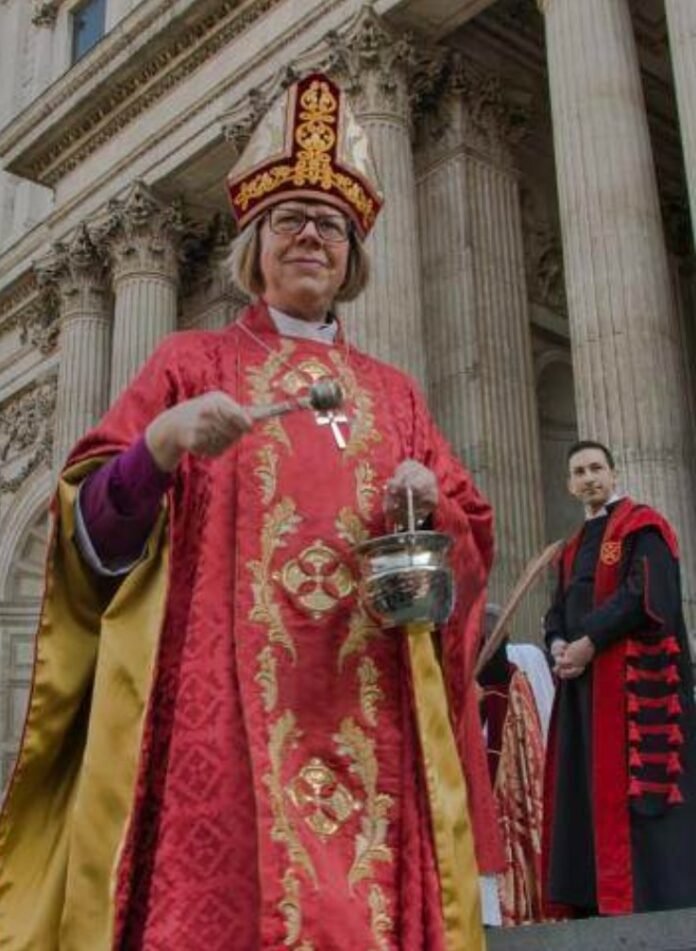
Five centuries after dispute over a woman caused Christendom’s biggest schism it looks like history is repeating itself. In 1534 King Henry VIII of England severed ties with the Roman Catholic church following the Pope’s refusal to annul his marriage with Catherine of Aragon. This so he could marry Anne Boleyn and get the male heir he so badly desired. The Act of Supremacy passed by the English Parliament declared the King to be the Supreme Head of the Church of England (CoE) and thus came into being the Anglican Church.
Three weeks ago Downing Street announced that King Charles had approved the nomination of Dame Sarah Mullally, 63, the Bishop of London, as the next Archbishop of Canterbury. She will be the first woman to hold the post and the 106th successor to Saint Augustine who arrived in Kent (where Canterbury is located) from Rome in 597 CE with a mission to convert the Anglo-Saxons to Christianity.
Dame (the female equivalent of ‘Sir’) Mullally is a trained nurse who spent 35 years in the National Health Service in the UK rising to become the youngest Chief Nursing Officer of England. She took a Diploma in Theology in 2001 and switched to becoming a priest in 2004 after which she obtained an MA in pastoral theology. Incidentally CoE ordained its first woman priest in 1994 while CSI did so ten years earlier in 1984. In 2018 Mullally became Bishop of London and the third most senior bishop in the CoE (after Canterbury and York). So her recent elevation (she takes charge next year) should not be all that much of a surprise.
The news of Mullally’s appointment has been met with both bouquets and brickbats. The CSI and the CNI are among several “provinces” of the Anglican Communion that have congratulated her on becoming the primus inter pares (first among equals) in the worldwide family of Anglican bishops.
The CSI statement posted on its facebook page said “we celebrate this historic moment with joy and gratitude as she becomes the first woman to hold this esteemed office.” The Archbishop of Canterbury is one of four instruments of the Anglican Communion with the others being the Lambeth Conference (held every ten years), the Primates Meeting (held every two years) and the Anglican Consultative Council (meets every three years).
There has been stinging criticism of Mullally’s selection from a broad swathe of Anglican Communion members. The Global Anglican Future Conference (GAFCON) a conservative grouping of Anglican Communion churches said it received news of the appointment of Mullally “with sorrow.”
Another grouping called the Global South Fellowship of Anglican Churches (GSFA), which has some overlapping members with GAFCON, said it was “deeply saddened” by the development. It described the appointment as “one further symptom of the crisis of faith and authority that has afflicted the Anglican Communion for the past quarter of a century.”
GAFCON chairman Archbishop Laurent Mbanda (seen in pic) of Rwanda went on to issue “The Future Has Arrived” communique on October 16 where he declared the grouping to be “now the Global Anglican Communion” He said its members “shall not participate in meetings called by the Archbishop of Canterbury including the ACC and shall not make any monetary contribution to the ACC, nor receive any monetary contribution from the ACC or its networks.”
GAFCON, which also goes by the title “Global Fellowship of Confessing Anglicans,” claims it represents 85% of the 100 million Anglicans worldwide. But independent estimates put the actual number at 55-60%. The mainstay of GAFCON is African churches including the Church of Nigeria (25 million), Church of Uganda (13 million), Anglican Church of Kenya (6 million), Church of South Sudan (3 million), etc.
The leaders of GAFCON like the bishops of Rwanda, Nigeria and Uganda have been boycotting meetings called by the Archbishop of Canterbury for a while and are now seeking to widen this boycott. To become a member of GAFCON, churches have to sign on (CSI has not) to its 2008 Jerusalem Declaration that inter alia binds members to recognize only marriages between men and women and to “reject the authority of those churches and leaders who have denied the orthodox faith in word and deed.”
The anger against Mullally is not so much because she’s a woman but over her having chaired a body that framed the CoE’s 2023 decision allowing its priests, at their own discretion, to bless (not marry) same sex couples and her calling it a “moment of hope for the church.” In mid October, following her appointment and the backlash that ensued, CoE bishops took two important decisions: to halt plans for “wedding” services for same sex couples and to defer a decision on clergy being allowed to enter same-sex civil marriage until there is agreement by two-thirds of the Synod.
Whether GAFCON and GSFA will be able to take on the might of the Anglican Communion led by the CoE depends on how many non-African churches join their ranks. Non-African members of either or both these bodies currently include the Anglican Church of North America (ACNA) — a breakaway faction of the Episcopal Church in the US and the Anglican Church of Canada — Anglican Church of Chile, Anglican Church in Brazil, Church of Bangladesh and the Sydney Diocese of the Anglican Church in Australia among others.
It is important to keep in mind that churches operate within a larger socio-political context and societal trends greatly influence changes in church policy on contentious issues. For instance the hardline position that churches once took took towards the ordination of women has eroded following their increased visibility and greater involvement in public life, Some churches even within GAFCON and GSFA support women’s ordination alongside those who don’t.
Homosexuality is today illegal in only some 65 countries in the world, mostly in Africa, Asia and the Middle East. In countries like Uganda, Yemen, Iran, Afghanistan and parts of Nigeria same-sex relations even today attract the death penalty. Given this, it will be hard for the churches in these countries to take the more liberal view the CoE takes in the matter. Part of the CoE move towards accepting same-sex relations is also driven by the urgent need to stop the steep decline in church attendance in the UK.
In India the Supreme Court de-criminalised same-sex relations between consenting adults in 2018. Hence, it is unlikely the CSI or the CNI will break ranks with the Anglican Communion on the same-sex issue.
But the larger question is whether the CSI should continue to be a “province” of the Communion given it is not an Anglican Church. At the time of its formation in 1947 only 50% of its membership came from the Anglican stream and the rest came from Presbyterian, Congregational and Reformed churches that merged to form the CSI. In fact, for this reason, the 1948 Lambeth Conference expressed reservations in accepting CSI as a member of the Anglican Communion. Full acceptance took almost a decade to achieve.
Given its origins as a reformist movement aimed at uniting different church traditions the CSI should perhaps follow what its sister church the Mar Thoma church has done: be in full communion with the Anglican Communion while retaining an independent status. Full communion only necessitates an ecumenical relationship allowing for sacramental sharing and cooperation. This without being integrated into the Communion’s governing bodies and recognizing the Archbishop of Canterbury as its spiritual head.