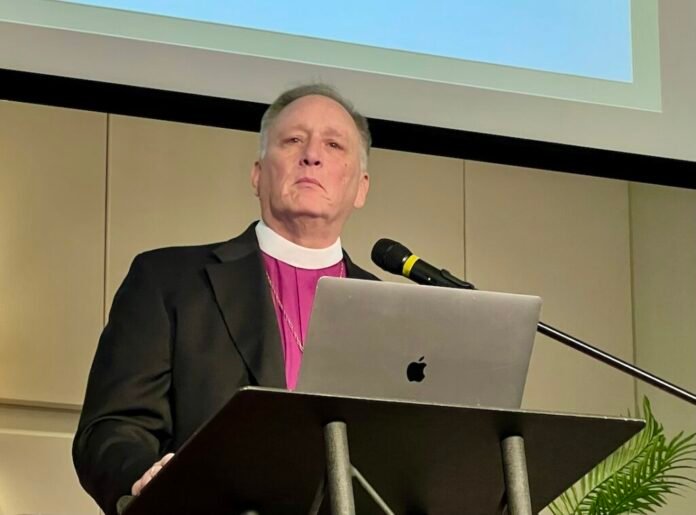
A dispute between the leadership of the Anglican Church in North America (ACNA) and its endorsing body for chaplains resulted in the latter unilaterally cutting ties with the North American church last week. ACNA endorses more than 300 chaplains, 187 of them in the U.S. military, twice the number endorsed by the Episcopal Church.
This dispute arguably evinces how American culture wars affect the church, as the departing bishop claims his allegedly woke denomination is punishing him for his outspoken views. Some online supporters have rallied to his defense.
But those bishops acting to temporarily restrict the departing bishop include some of the traditionalist denomination’s most conservative. It’s unclear how many of ACNA’s 300 chaplains, some of whom allege professional abuse by a heavy-handed bishop, will follow him out of ACNA. Early indications are that it will be a small minority of those serving. Some of these chaplains have privately shared their abuse stories with IRD.
The departure came as ACNA Archbishop Steve Wood on September 21 placed a 60 day inhibition on the ministry of Special Jurisdiction of the Armed Forces and Chaplaincy (SJAFC) Bishop Derek Jones, citing a series of “credible complaints” alleging abuse of ecclesiastical power (Warren Cole Smith of MinistryWatch cites an unnamed provincial source stating that since July at least nine complaints have been formally made against Jones, IRD has separately been told by chaplains that there are 16 in total).
“These complaints did not involve physical or sexual misconduct, nor did they involve any doctrinal concerns,” Wood wrote in a September 23 pastoral letter released on the provincial website. “Nevertheless, they were concerning because abuse of ecclesiastical power violates the trust that is essential for effective ministry.”
Those alleged abuses include backdating church documents (one provided a document from Jones sent with an earlier date the day before his departure when still under ACNA authority). Two chaplains alleged that Jones went after them to interfere with outside employment after they departed, while others alleged he inflicted “financial, emotional, and psychological stress.” These chaplains served across multiple tours in war zones and continue in their U.S. military roles with other endorsing agents.
“I will crush you,” one chaplain summarized of a series of options Jones gave him. “I will never stop coming after you,” the chaplain’s new endorser outside of the ACNA relayed that Jones had effectively told him of his intention towards the chaplain.
A presentment has not yet been made against Jones. The inhibition was issued, according to Wood, only after he and Dean of the Province and Presiding Bishop of the Reformed Episcopal Church Bishop Ray Sutton issued a “Godly Admonition” to Bishop Jones that included a directive for him and his subordinates within SJAFC to cooperate with an investigation. A Godly Admonition is a canonical act that may require a bishop to undergo a form of remediation such as counseling or training. It can be followed by discipline if it is not complied with.
The ACNA summary provided on its website states that Jones refused to comply with the directive and Wood temporarily inhibited Bishop Jones from ministry for 60 days on September 21.
The SJAFC Executive Committee announced its withdrawal from the Province the following day.
Public Dispute
The dispute has played out publicly, with the ACNA providing a page on its website complete with a timeline and documents including the Archbishop’s letter. The SJAFC has similarly provided statements on its website contesting the Archbishop’s letter as presenting “a false and misleading account of the events.”
While the SJAFC is among the smallest bodies in the ACNA measured by average Sunday attendance (250), membership (288), and churches (9) in 2024, it has also been one of the Anglican province’s success stories, endorsing more than 300 chaplains.
Multiple clergy complainants and other chaplains spoke on background with the IRD to share their experiences serving under or interactions with Jones. Their anger at the JFAC bishop was matched only by their frustration with ACNA officials and bishops who, some insist, downplayed or slow-walked their complaints going back at least four years, long exceeding the July timeframe for complaints in provincial correspondence. Elected in June of 2024, Wood took office with more disciplinary authority than his predecessor Archbishop Foley Beach through canonical changes adopted by Provincial Council in 2021 and approved by the larger Provincial Assembly in 2024.
Among the complaints against Jones are a “pay to play” tithing policy that mandated all endorsed clergy directly give 10 percent of their income (a matter of public record for military chaplains) directly to the jurisdiction before giving to their local church or Christian ministries. If true, this could be a violation of federal law in which financial contributions to a tax-exempt 501(c)(3) organization cannot be mandated as a condition of employment. If that restriction also covers endorsement is less clear.
Multiple people interviewed expressed fear that Jones, even departed from the ACNA, could exact retribution if they spoke out publicly, citing heavy handed discipline and a record of vindictive pursuit against those who had prior departed the SJAFC for other endorsing groups.
Two chaplains allege that Jones keeps extensive records of compromising information on others, including fellow bishops, and is often underestimated. One pointed to an attempted “hostile takeover” of the Reformed Episcopal Church’s endorsement status, with Jones seeking to convince the other ACNA subjurisdiction, among the oldest chaplain endorsers for the U.S. military, that they could no longer endorse independently of him.
That last point is consistent with a record of Jones seeking to consolidate his authority within the ACNA. Unlike the Episcopal Church, in which chaplains maintain canonical residency in their home diocese, the SJAFC has placed the canonical residency of most ACNA chaplains under a single umbrella. That afforded Jones unprecedented control over Anglican chaplains, effectively mandating that they go through him alone. Simultaneously, in a “one foot in, one foot out” strategy, Jones would tout ACNA affiliation while simultaneously seeking maximum autonomy from accountability to the broader province through an appeal to subsidiarity.
That strategy played out across the past week, as Jones directed chaplains not to cooperate or even communicate with ACNA officials. His directive has not been widely heeded, however: every chaplain that spoke on background with the IRD, including those who expressed no grievance with Jones, stated plans to remain within the ACNA and not separate as Jones had.
Absent Jones, the ACNA’s structures appear to have carried on. The College of Bishops met in virtual session on September 25 and elected Jerome R. Cayangyang as Bishop of the Armed Forces and Chaplaincy following Jones’ declaration of his disaffiliation and separation. Cayangyang previously served as Suffragan Bishop of the SJAFC under Jones. Replacing Jones as an endorser has been conveyed by the Archbishop’s office as a paperwork matter already underway and expected to be completed in under 30 days.
“At no time should any [ACNA] serving chaplain or chaplain candidate be concerned about their endorsement or ability to serve the Armed Forces,” Chaplain (COL) David Wake, Executive Director of the Armed Forces Chaplains Board in the Office of the Deputy Secretary of War for Personnel & Readiness wrote to Wood on September 24. “My expectation is all should be able to continue their service without interruption, and I know all three Chaplaincies are committed to the same goal.”
Pressure Points
What is being presented by the province as effectively a done deal is still playing out on social media. Jones last week held an “all hands” hourlong virtual meeting with chaplains that was part refutation of allegations against him and part appeal for chaplains to follow him out of the ACNA. The video, informally filmed on Jones’ porch, has already garnered more than 3,000 views, despite the Anglican Chaplains YouTube channel having only 154 subscribers.
The now-former ACNA bishop has sought to cast the dispute as theological or political difference, appealing to conservatives as a standoff with the archbishop. That framing of the crisis has appealed to some ACNA traditionalists who harbor suspicions of “woke” infiltration of the conservative denomination, some of which point to swift and direct intervention when Anglo-Catholic clergyman and online commentator Calvin Robinson was briefly licensed under an ACNA diocesan bishop. Meanwhile, leftist clergy who eventually departed for the Episcopal Church were left to the discretion of their diocesan bishop and permitted cordial transfer.
Complainants in the case refute this, arguing that Jones is aware of “pressure points” in the ACNA and seeks to exploit them as a wedge amidst a case that has no political or theological ramification and is strictly about misconduct. Additionally, the 60-day inhibition of Jones was signed off on by four of the five senior-most bishops in the ACNA (by date of admission into the College of Bishops), among them leading traditionalists. The Archbishop’s office declined to confirm for IRD the names of those four bishops, citing the confidentiality of the inhibition. Jones in his video publicly named Bishops Todd Hunter (Diocese of the Churches for the Sake of Others), Bishop Eric Menees (San Joaquin), Juan Alberto Morales (Quincy), and Julian Dobbs (Living Word) in his video, the latter three are regarded as among the more conservative within the College.
Fractures within the ACNA are not unprecedented. In 2010, Bishop Chuck Murphy of the Anglican Mission in America (AMiA), a founding jurisdiction of the ACNA, sought to pull the ecclesial body back from its full membership in ACNA and the Anglican Church of Rwanda (with which it held a dual status). According to Christianity Today, relations between Rwandan bishops and Murphy soured over financial accountability and control issues. Approximately one-third of AMiA churches followed Murphy, while a majority remained affiliated with ACNA and the Anglican Church of Rwanda. The AMiA reorganized itself as a mission society and continues as a parallel jurisdiction that has a working relationship with ACNA.
Further Resources:
ACNA Inhibits its Chaplaincy Bishop (Arlie Coles, The Living Church)
Military Chaplains Attempt to Leave ACNA En Masse (Warren Cole Smith, Ministry Watch)
Anglican Unscripted Episode 933 Anglican Chaplains (Kevin Kallsen, Anglican TV)
IRD Coverage of Bishop Jones: