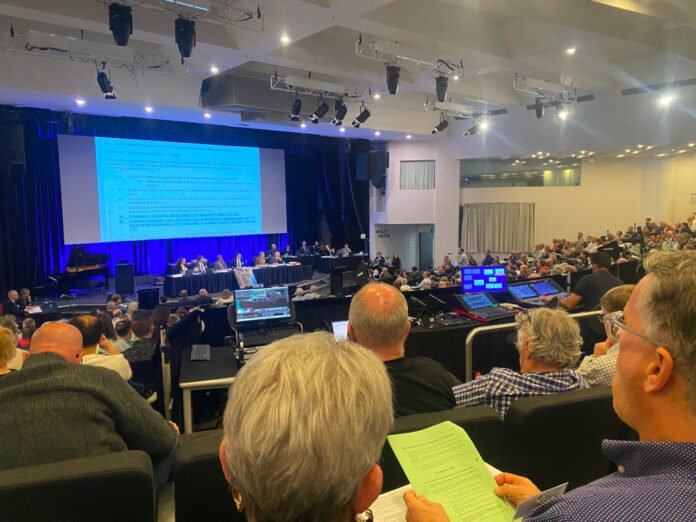
Clergy, churchworkers, and any Christian taken before a tribunal when accused of breaching the Conversion Practices Ban Act in NSW have been assured by Archbishop Kanishka Raffel and the Sydney Anglican Synod that they will be supported. “I concluded by saying, and I want to say this clearly and publicly to you all, that I will stand by any clergy person or church worker who finds themselves brought before a tribunal or court because of this poorly conceived law,” the Archbishop declared in his presidential address to the Synod, repeating an assurance he had sent to his clergy as the new law began to operate.
“We must not be silenced, he added. “We must not be silenced or intimidated from teaching God’s good plan for human sexuality and relationships. We will insist on the freedom to do so respectfully, but without fear, we will obey God. We can do nothing less.” During the debate, Raffel made it clear his support extended to lay people caught up in tribunal hearings as well.
Moving the Synod motion, Bishop Michael Stead explained that for the first time he could be breaking the law in carrying out Christian ministry. The Premier had broken a promise made before the election not to ban prayer. “A group of faith leaders worked extensively with the government to arrive at the legislation so that it would not capture ordinary religious practices, and we thought that we had achieved that through a series of exemptions in the act. We were led to believe that the Act, unlike the Victorian Act, distinguished between sexual orientation and sexual activity and that it was not a change or suppression practice to teach someone to abstain from sexual activity contrary to the Bible’s teaching… The government told us at the time, quote, our bill has powerful protections for people of faith, that it, quote, protects the rights to prayer, that it does not stop you telling someone not to have sex before marriage.
“However, the implementation of the act, which is in the hands of Anti-discrimination New South Wales, does not deliver on these promises. The Anti-discrimination New South Wales website says that teaching or prayer directed to change or suppress a person’s sexuality or gender identity is a conversion practice and will be unlawful even when a person asks for it themselves. We have engaging extensively with Anti-discrimination New South Wales since the bill as it change as to whether certain religious practises were conversion or suppression practises, they said they cannot answer our questions, they cannot give us guidance because there is no case law. Until this happens, they intend to give the maximum interpretation to the definitions in the act, for the benefits of those for whom the act was created – presented to the LGBT community. This means that they will accept all complaints that fall into the unknown, the grey area – and wait for these complaints to work their way through systems of tribunals and courts to ultimately discern what is a suppression practice.
“Now, at the end of the day, I expect that many of the things won’t actually turn out to be forbidden practices, but the problem is that the process is the punishment. Providentially. I happened to meet with Bishop Julian Porteous this morning, and he just happens to be in Sydney, and we were able to chat over what it was like to be dragged through a complaint process.”
The advice from Anti-discrimination NSW was for religious leaders to stay out of the grey zone. The risk at this stage was self-censorship.
“In the meantime, … the one thing we must not do is to be cowed into silence because of the fear of complaints for prosecution.
“However, I think that there is a very real risk, I mean a genuine risk for us at this legislation, especially in light of the Anti-discrimination New South Wales website to intimidate us into self-censorship even when the conduct is not unlawful. Tragically, this has been what has happened in the Diocese of Melbourne. The Melbourne diocese requires church workers to sign a declaration that they’ll not contravene [Victoria’s Change or Suppression Practices Prohibition Act 2021.”
Stead re-stated the view of the diocese on LGBTQIA persons. “People do not have to convert their sexual orientation to heterosexuality in order to be converted to Christ. We welcome and embrace our same-sex-attracted brothers and sisters as members of Christ. We embrace those we experienced gender incongruence. They don’t have to change, and we’re not trying to suppress who they are. We love them as they are. At the same time, we have previously said and we should continue to say that we will pray for same-sex-attracted Christians that they should lead celibate lives and that prayer like this is not a conversion practice.”
Dominic Steele, Senior Minister at Village Church in Annandale, described how the law forbids practices he has engaged in. “The Archbishop said on Monday, I’ll stand by a clergy person or church worker who finds himself before a tribunal or court because of this poorly conceived law, and I, like most in the room, applauded at that point. … I’m really grateful to you, Archbishop, here. As an inner city rector, I have prayed for and with many people for the work of the Spirit in their lives. Christian people experiencing same sex attraction and Christian people experiencing gender incongruence.
“When the law was proposed, I met with our local MP and said to her, I understood the law which was being proposed. I thought it was possible that I would break the law when it passed. And so, as a point of integrity, I wanted her to know this. I wrote to the Attorney-General saying something similar.”
Steele moved an amendment to thank the archbishop for standing with the Clergy, and during the debate, Raffel made it clear that his earlier promise to the clergy applied to church workers and teachers as well.
A member of Synod [de-identified at the request of a senior member of Synod] described the result of counselling LGBTQIA persons. “We have dealt with a number of cases of people in our parish coming and asking for help and prayer in many sorts of difficulties around LGBT stuff over the years. And some of them have been very difficult, painful conversations that we have had to go through.
“I reflect back a few years to when I’ve had a very difficult conversation with someone, in our church, who had been secretly dealing with gender dysphoria … and had been outed by someone, and it became a huge issue. And we had some very strong conversations.
“We prayed together, we argued, and about two years ago, he came to see me and said, ‘I just want you to know I hated your guts and I thought about punching you out many times, but I thank God and pray, and I heal, and my wife thanks you.’ I think, had the law.. been out when we were having those arguments, I would’ve been going to a tribunal.”
Anglican Media’s Russell Powell warned the Synod that if someone is prosecuted under the Conversion Practices Ban Act, it will be an ugly process. “When this first happens, when the first person goes to court [or] tribunal, it will be ugly. Persecution is not clean. I think we think, probably like the Apostle Peter and others, that we’d be there at the barricades and everybody will support us. [But] when things like this happen, people fly away. People who previously said things like, ‘we will stand by you,’ say, ‘well, yes, I would, but it’s just the way you did it. I’m really in support of this. But you shouldn’t have done it that way.’ So leading you to believe you are somewhat to blame for it.
“So when this happens, we won’t be dragged to jail for 24 hours and then get out to the cheers of people. [Instead,] it will be a long, messy process through tribunals. The papers will come, they’ll report, make up things even. And your friends will say, if ‘I had said that differently, it would’ve been better.’ ‘Not a very good witness.’ ‘I mean, I support the theology behind it, but not the way you did this.’
“Support them.
“The Archbishop has pledged to support them. I know he’s sincere about this, and he understands these kinds of situations because he’s been through it. But I want you to remember this and to tell all your friends that no matter what is reported, no matter how people view what has been done, support them because they’re our brothers and sisters, and we know them and we know their sincerity. And even if they have made mistakes.”
The motion
Synod –
(i) reaffirms the position of Synod, as previously stated in resolution 31 of 2018, that the Anglican Church in the Diocese of Sydney does not practise, recommend or endorse ‘gay conversion therapy’, being psychological practices that seek to re-orient sexual attraction to heterosexuality, and that Synod values prayer for same-sex attracted Christians who wish to live celibate lives, noting that prayer is not a
form of ‘gay conversion therapy’,
(ii) notes that the Conversion Practices Ban Act 2024 (CPB) came into effect on 5 April 2025,
(iii) notes that on 27 February 2023, the Hon Chris Minns promised Christians and other people of faith that ‘an individual of their own consent seeking guidance through prayer will not be banned’,
(iv) notes that guidance material prepared by Anti-Discrimination NSW (ADNSW) states that prayer ‘directed to change or suppress the person’s sexuality or gender identity … is a conversion practice, and will be unlawful even when a person seeks them out for themselves’, and
(v) notes that ADNSW has advised that it will accept complaints under the CPB Act when someone has prayed with a same-sex attracted person that he or she would only act on their sexual desires consistent with the teaching of the Scriptures of their religion, and therefore –
(a) thanks our Archbishop for his commitment to stand by any clergyperson or church worker who finds themselves brought before a tribunal or court because of this law.
(b) encourages Christians to be unafraid to proclaim the truth of God’s word in matters relating to sexuality, marriage, identity and gender, and to provide prayer for those who seek to live a godly life in obedience to God’s word and aligned with God’s purposes, notwithstanding that they may be subject to a complaint under the CPB Act for doing so,
(c) commends to parishes and organisations the work of Living Faith, as it seeks to provide biblical teaching, encouragement and support to Christian men and women who experience attraction to the same sex or gender incongruence as they seek to express their sexuality and gender in accordance with the historic Christian faith, and to assist parishes to welcome and love these men and women,
(d) noting the recent appointment of Canon Emeritus Peter Rodgers as the Executive Director of Living Faith, encourages Sydney Anglicans to pray for him, and calls upon the NSW Government to uphold the Premier’s pre-election commitment in relation to the CPB Act, that ‘an individual of their own consent seeking guidance through prayer will not be banned.’
This report has been amended to suppress the name of one Synod member at the request of a senior member of Synod, and to correct some errors in the Bishop Stead speech.