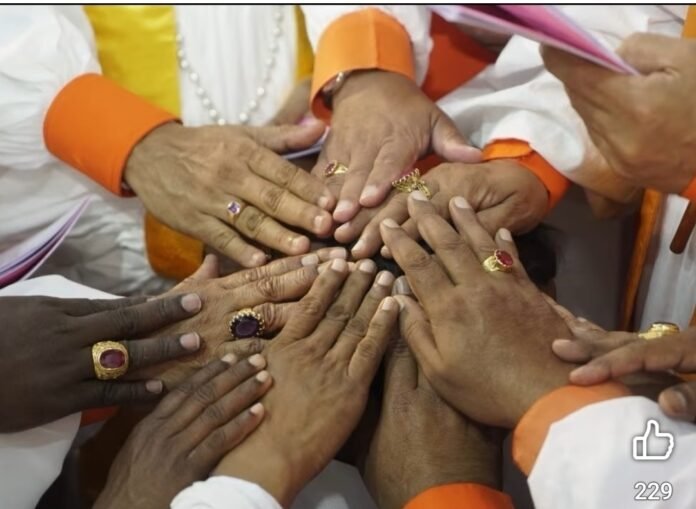
The consecration of six new CSI bishops in the space of two weeks between August 3-16 is undoubtedly a record of sorts. But what is perhaps more important is that four of the six bishops appointed were in keeping with the popular mandate they received from their respective dioceses.
The bishops of Madras, Nandyal, Cochin and Erode-Salem were all number 1 on the panel of four candidates (see examples of Cochin and Nandyal attached) that were sent by each diocese to the Synod for selection and appointment. To the extent that no nasty surprises were sprung — like the No 4 candidate on the panel being selected bishop as has happened in the past — it must be said that by and large the selection was in keeping with the electoral results.
The only exceptions were Karnataka Central (KCD) and Kollam-Kottarakara (KKD) dioceses where the No 2 candidates were chosen over those who had secured the most votes in the bishopric election. Well placed sources say in KKD the No 1 candidate Rev Vinod Allen being a presbyter from Malabar diocese was a major disqualification. In recent years the Synod has made it an almost unwritten rule that a presbyter cannot move to another diocese simply to contest for bishop.
Besides the KKD itself was carved out of South Kerala diocese in 2015 primarily to meet aspirations of its overwhelmingly dalit membership. And hence not appointing one of their own as bishop would have meant a sad and avoidable history repeating itself. Bishop Oommen George as first bishop of KKD and a non-dalit was parachuted in from Madhya Kerala diocese and appointed in 2017 during the tenure of then Madhya Kerala bishop and Moderator Thomas K. Oommen. This after George had failed to make it as bishop after contesting bishopric polls in two other dioceses.
With only 84 diocesan council members it is not too difficult to influence the outcome in KKD, CSI’s smallest diocese, in a bishop election where less than four dozen votes is all it takes to get on to the bishopric panel. Hence even though his candidature was backed by an infuential powerbroker and reportedly supported by the former bishop, Rev Allen had to make way for Rev Jose George, the incumbent secretary of the diocese, the No 2 candidate.
In the case of Karnataka Central it is learnt the selection board members were overwhelmingly in favour of Rev Dr Dexter Maben (seen in pic), the No 1 candidate, except for Moderator Reuben Mark. As chairman of the selection board he decided that since the No 2 candidate Rev Dr Vincent Vinod Kumar, 60, has less than seven years until retirement he should be appointed. There is no system of voting that applies in the selection board comprising six members and the moderator. Dr Maben, who is 54 years old and has 13 years of service left, will have another opportunity to contest for bishop, the moderator reportedly told his colleagues on the selection board.
It would be wrong to assume the Moderator was singularly responsible for making the above decision. His fellow Synod officers General Secretary Fernandas Rathinaraja and Treasurer Vimal Sukumar would also have had an equal, if not greater say, in the decision making. It was always known that the close association Synod officers have with a key power broker in the KCD as also with the former bishop of the diocese will make merit secondary in its bishop appointment. See “Three Vinods and One Varkey All Set to Flash “V” for Victory https://www.facebook.com/share/p/1GGQxDRKFp/
The KCD has been a milch cow for Synod officers in recent years particularly in fighting the hugely expensive legal battles including at the Supreme Court level. These battles were avoidable, resulting largely from the autocratic and undemocratic decisions of the current Synod officers and the erstwhile Moderator. Recently two Synod officers had to personally finance their own petitions at the apex court, seeking to be restored to office, that were filed in an individual capacity. Also there are highly controversial big ticket property deals in KCD that currently hang in the balance.
It was clearly not the age factor that influenced the decision on the KCD bishop. Because except for the Madras bishop, 60, the new bishops of Nandyal, Kollam-Kottarkara, Cochin and Erode-Salem are all contemporaries of Rev Dr Maben in terms of age. Cochin Bishop Kurian Peter is 54, Erode-Salem Bishop Jacob Livingston is 56, Nandyal Bishop Santosh Prasanna Rao is 52 , and Kollam-Kottarakara Bishop Jose George 55. Which makes it evident that Dr Maben being 54 was not the real issue.
There is something fundamentally flawed in how CSI chooses a bishop. To expect a selection board that hardly meets for 2-3 hours to arrive at the decision after thoroughly vetting each candidate (whose papers are given to them only at the meeting itself) is expecting too much. And considering that CSI bishops enjoy long tenures – typically over 10 years – once appointed there needs to be more rigour exercised in selecting a bishop. Ideally candidates should be vetted by a qualified nomination committee, comprising both diocesan and synod representatives, before their names are put up for election by the diocesan council.
For instance, in the Church of England (CoE) there is a Crown Nominations Committee (CNC) comprising six members elected by the General Synod (in CSI’s case appointed from among Synod Executive Committee members belonging to dioceses other than the one for which bishop is being appointed), six members elected from the Vacancy-in-See Committee of the relevant diocese (who can provide valuable inputs into the needs of the diocese from a future bishop), two archbishops of Canterbury and York (in CSI’s case would be the Moderator and Deputy Moderator) and two non-voting members including the Prime Minister’s Appointments Secretary.
Candidate bios are scrutinized in detail, interviews held with contenders and a two thirds majority vote of the CNC is required to send one name (or two) to the King via the prime minister for appointment. This makes for a very detailed and necessary winnowing process. Following that, the College of Canons of the diocese formally ‘elects’ the bishop appointed by the King as a matter of formality.
I am explaining this CoE process only to emphasise three things. One, there is a fairly large selection body comprising both synod and diocesan reps involved; second, the high level of scrutiny a candidate for bishop receives (which is inadequate in the CSI) and; third, that there is a vote of the selection body that decides the outcome not the arbitrary decision of the Moderator/Synod Officers as is evident in the KCD case.
Even in the case of the Marthoma church, which is in communion with the CSI, an Episcopal Nomination Board first conducts a detailed review of all nominations it receives. Only those recommended by the Board are put up for election by the Mandalam (the church’s legislative body comprising both clergy and laity) and a candidate has to get 75% of the votes to be appointed bishop.
It is hoped the CSI would set up a committee to recommend how proper scrutiny of bishopric candidates can be instituted before they are put to vote in the diocesan council and not after they are elected. The Synod’s role should be limited to being part of the scrutiny and then addressing only issues of electoral irregularities, if any, after the election.