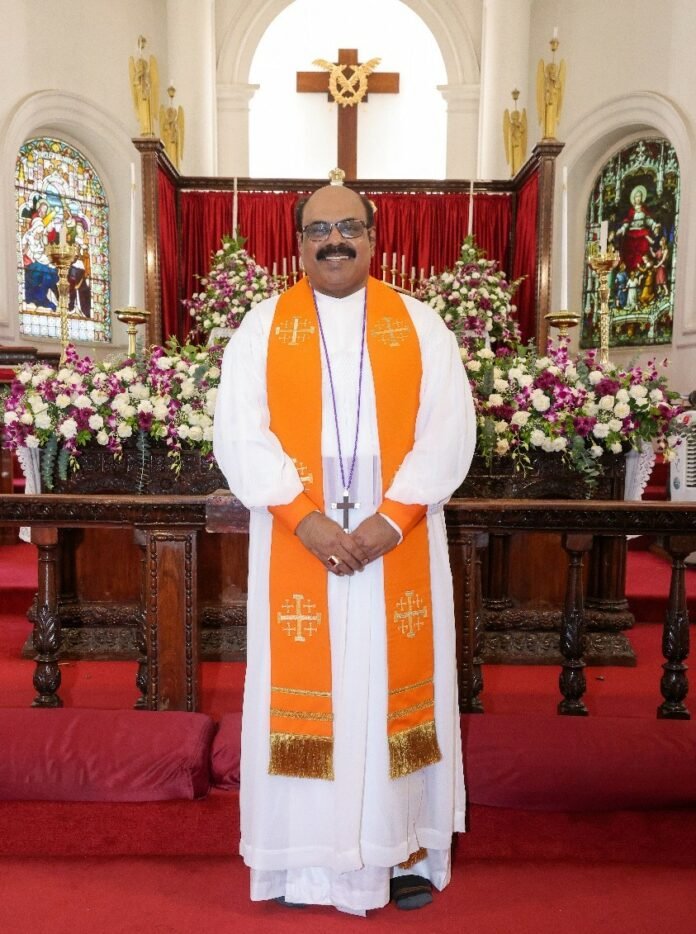
The Church of South India (CSI) has appointed the Rev. Dr. Vincent Vinod Kumar as the new Bishop in the Karnataka Central Diocese. His consecration took place on 11 August 2025 at St. Mark’s Cathedral, Bengaluru, with the Moderator of the CSI Synod, the Most Rev. K. Reuben Mark, presiding.
Born on 24 April 1965, Bishop Kumar was ordained deacon in 1991 and presbyter in 1992. He earned a Bachelor of Theology degree from South India Biblical Seminary, Bangarpet (1986), a Bachelor of Divinity from United Theological College, Bangalore (1991), a Master of Theology from Tamilnadu Theological Seminary, Madurai (1997), and a Doctor of Theology from Presbyterian University and Theological Seminary, Seoul, Korea (2013) Prior to his election he served several congregations, including Hudson Memorial Church, Shaffer Memorial Church, CSI Tomlinson Church, Stean Memorial Church, Sawday Memorial Church, William Arthur Memorial Church, CSI Church (Kunigal), Wesley Church (Tumkur), and the last posting was at St. Mark’s Cathedral. At the time of his election he served as secretary of the executive committee of Karnataka Central Diocese.
The Karnataka Central Diocese, headquartered in Bengaluru, traces its roots to the Anglican Church’s presence in South India during the colonial period. St. Mark’s Cathedral, where Bishop Kumar was consecrated, has served as the spiritual heart of the city’s Anglican and later CSI life since its consecration in 1816.
The diocese is among the most prominent in the CSI both for its location in the state capital and for its role in shaping theological education and ecumenical dialogue. It shepherds a wide range of urban and rural congregations in the central districts of Karnataka.
The Church of South India itself was founded in 1947 through the historic union of Anglicans, Methodists, Presbyterians, and Congregationalists. It was the first such union of episcopal and non-episcopal churches anywhere in the world, and continues to be a significant expression of global ecumenism, maintaining communion with the Anglican Communion while also incorporating reformed traditions.