In an effort to slow the spread of the coronavirus, every state in the United States has issued guidelines or orders limiting social interaction. But these rules don’t always apply evenly when it comes to in-person worship services and other religious gatherings.
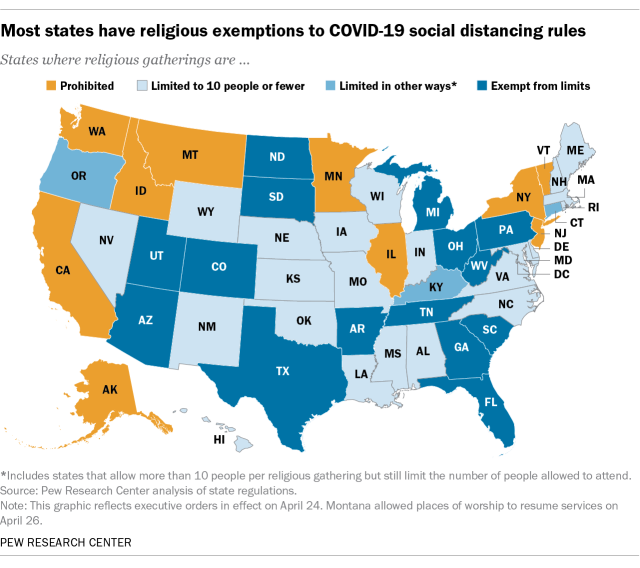
In fact, only 10 states are preventing in-person religious gatherings in any form, according to a Pew Research Center analysis of recent state-level regulations. The list includes California, where a group of churches are suing Gov. Gavin Newsom in federal court over what they claim is a violation of their First Amendment right to free exercise of religion. A federal judge last week rejected their request to hold services.
How we did this
Perhaps with such litigation in mind, most other states have carved out exemptions for religious gatherings in their stay-at-home orders or other directives in an attempt to balance religious freedom concerns with safe social distancing practices. The Centers for Disease Control and Prevention (CDC) continues to recommend that gatherings of more than 10 people be canceled, while in gatherings that do take place, individuals should remain at least 6 feet apart at all times.
In some cases, states have deemed religious worship “essential,” in the same category as food shopping and health care. These states include Florida, South Carolina and Tennessee, among others.
Roughly a third of states (15) are allowing religious gatherings to continue without any limit on their size.
Twenty-two states and the District of Columbia have specified in their orders that religious gatherings can take place, but only if they are limited to 10 people or fewer. This includes Rhode Island, where gatherings are limited to no more than five people. Two additional states, Connecticut and Oregon, limit religious gatherings to 50 and 25 people, respectively. Kentucky, meanwhile, is prohibiting “mass gatherings” – including faith-based ones – but does not specify how many people constitute a mass gathering. (This analysis only examines state-level regulations as of April 24 and does not reflect changes in regulations after this date.)
In some cases, religious leaders have resisted state orders, holding services in defiance of warnings from officials. But many others have canceled services in an effort to comply with the CDC guidelines, despite state-level exemptions that could allow them to continue communal worship.
Some congregations have gotten creative, not only with livestreaming services online or on television but by holding “drive-in” religious services, where people can participate in services from cars that are spaced 6 feet apart, rather than inside a house of worship. To date, seven states explicitly allow this sort of gathering to take place, while many others encourage religious organizations to host services online.
Correction: An earlier version of this post miscategorized New Mexico’s rules. New Mexico’s order was revised on April 11 and now specifically requires houses of worship to adhere to the state’s guidelines prohibiting gatherings of more than five unrelated individuals. Consequently, the totals for states with no limitations and states that allow religious gatherings of 10 or fewer have been updated.




Here in Wake County, NC, the capital city, county leaders have issued “guidance” specifically prohibiting the distribution of Holy Communion. Among its helpful suggestions was the idea that congregants could “bring their own communion from home.”
Sorry, I misquoted. They suggest church members can “bring their own sacraments from home.” Even worse.
This is yet another example why politicians should not perform theology.
Far too many elected officials have truly enjoyed their first taste of totalitarian rule and are not ready to relinquish their experience of it.
And by and large the Church has complied with nary a whimper……….
… Which is probably as it should be and not quite accurate at the same time.
Did you read this bit: “Some congregations have gotten creative, not only with livestreaming services online or on television …”
I would say that it actually an understatement. It should say “Most, if not all” instead of “Some.”
From what I’m seeing every church has responded in some appropriate way to minister both to their congregations and to many outside them.
Now is defunitely not the time to waste energy, resources and effort fighting governments. There will be time for that once this is over and we realise that ALL our worst fears never materialized.
I will also go out on a limb and say that those churchs which focused on needy people will find themselves in a much better place once this is over. Those that chose to focus instead on supposed “government overreach” will be hurting.
How might Paul have addressed it: Let those who can meet, meet and give thanks. Those that cannot meet, give thanks in your own homes and look forward to the day you can. In either case bend your hearts, minds and strength into helping those in need. — just maybe.
As Rahm Emmanuel said, never let a crisis go to waste. This is a great map and summary of if/how states have tried to squash religion in an epidemic, but it would be nice if they had links to each state’s orders or policies. I’m not sure that Illinois has exactly “prohibited” religious gatherings, per se, but it has prohibited gatherings of more than 10 people. Unlike the in Church of England, leaders haven’t been told not to stream services from within the church buildings.