
“There’s stability in God and those who follow Him must not deceive themselves that through sophistry they can confuse Him; because there is nothing like ‘modern God’, it does not exist.”
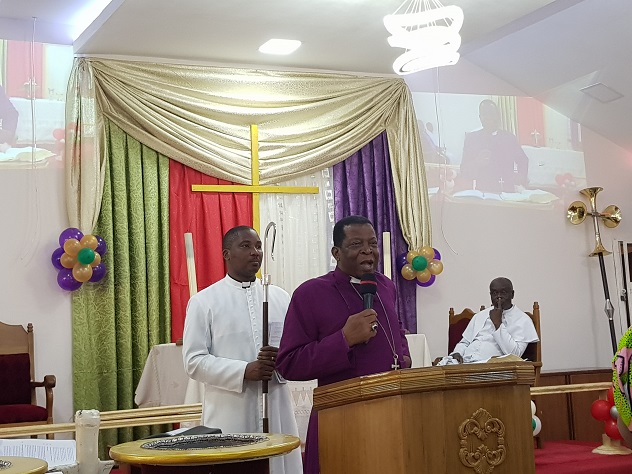
These were the words of the Primate of all Nigeria Anglican Communion, and Bishop of the Diocese of Abuja, the Most Rev. Nicholas D. Okoh at the dedication of a new place of worship for the parishioners of All Saints’ Anglican Church, Wuse Zone 5, Abuja, pending the building of a new ultra-modern church building to replace the old one.
The Primate, who described dedication as separateness, said that this is the call of every Christian, to be separate from the world through the way they live and do things. He opined that there was a time when there was a clear cut difference between what is acceptable and what is unacceptable, and what is Christian and what is unchristian. According to him, today, people have reasoned things so much that anything has become acceptable and people, including those who profess to be Christians, now talk of relativism, whereby there is no absolute truth. This, he said is the crux of the problem, the reason there is so much crises in the Church today.
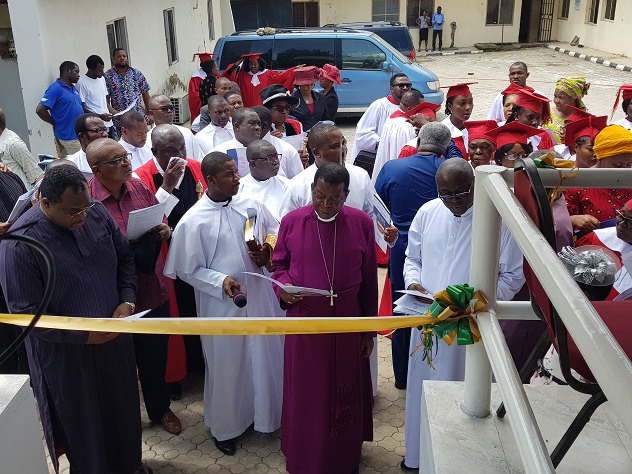
Primate Okoh further explained that dedication is to make a place holy and set it apart from all forms of common uses. He stressed that the dedication of a church building makes it a colony of Jesus and a place where Christians can run to in times of need and when in trouble, to receive answers and solutions to their problems, as well as safety. The cleric said the church is not a place to brag or misbehave, but a place where all must be clothed with humility.

The Bishop of Abuja Anglican Diocese pointed out that in the relationship between God and man, the gap is very wide and man cannot challenge God; because He is the creator while man is the creature. He described God as the immortal one, who is not confined by space and time, as man; stating that God does not take permission from anyone to do anything and therefore believers must be humble whenever they come into His presence. He quoted the Bible verse that states that God resists the proud and exalts the humble to corroborate his point; adding that when a person is humble, he or she will receive answers to his or her prayers and also be able to fellowship peacefully with others.
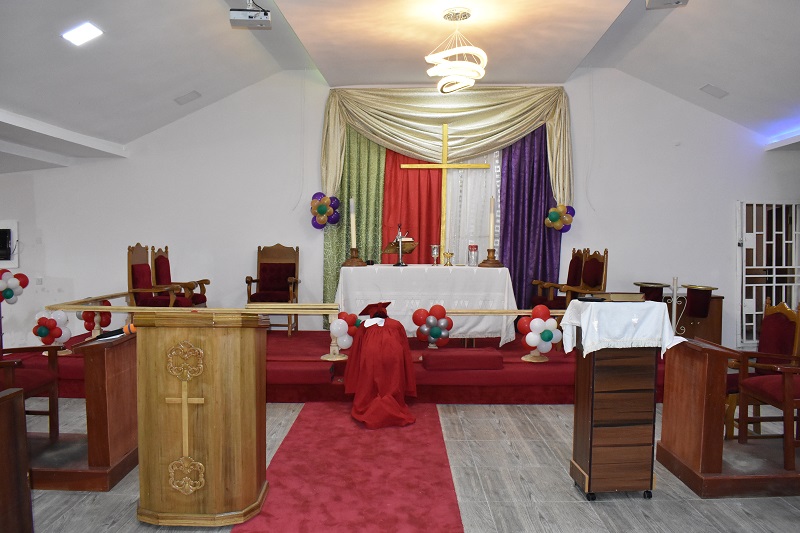
The Most Rev. Nicholas Okoh ended his sermon with a charge to all present to run to the house of God, to seek His face when they are joyful, sad, in need, in trouble or when they are being persecuted unjustly and God will answer their prayers, protect them and fight their battles. He however added that one must make sure that one is suffering for Christ’s sake and not for one’s sin. He said if suffering comes as a result of personal sin, one must first repent, before one’s prayers can be answered, because the spirit of God cannot cohabit with sin.
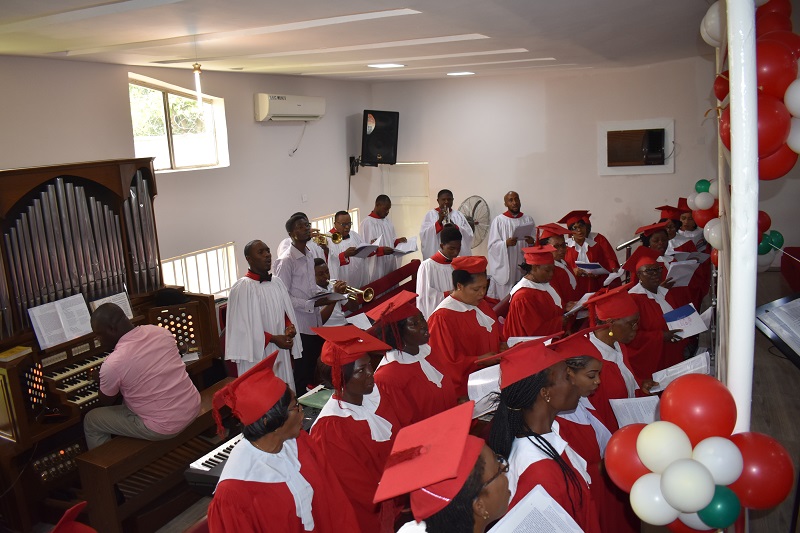
Highpoints of the dedication include the dedication of the Font, Lectern, Pulpit, Prayer desk, Choir stall, Chancel step, and the Holy table (Sacrarium). The alternative church building though modest is commodious, with modern gadgets and big enough to accommodate two services as if it were the old structure. It is a beauty to behold.



Okoh doesn’t even mention modernism.
He does not mention heresy either so far as I can see. “…there is nothing like ‘modern God’, it does not exist.”
What does that general statement even mean? What kind of God does this archbishop worship? A medieval one?
I am Well aware of modernism and how some consider it but my point was that his phrase is terribly general and barely makes sense. And where does he use the word heresy?
The actual title of the press release (from the Church of Nigeria Anglican Communion press office is “There is no ‘modern God’; relativism is the bane- Primate Okoh”. The sensationalist title is from some other source.
The point is simply (and obviously) that there is one God, and that He is the same God in both ancient and modern times. The body of the sermon (as reported in the article above) continued with references to the biblical injunctions that we should seek out God and be humble before Him, and that these still apply. It might be helpful to have a transcript of the sermon, to be able to read it without the reporter’s “lens” in the way.
Keep in mind that in Nigeria, there are not only Western influences to deal with, but also several “pseudo-” and “neo-” Pentacostal movements that are preaching new revelations beginning in the 19th and 20th centuries that override the scriptural Gospel, and the “prosperity” gospel whose adherents in Nigeria alone outnumber any Western Anglican province.
Not sure about the technicality of the language (“modernism”), but he seems to be clearly addressing the comfortable double-speak that has replaced genuine faith in many circles. It is so common to reject the infallibility of scripture. And it seems very common to imbue “God” with only those characteristics that we want him to have. To respond to this with the clear assertion that God is Creator and we are his creatures rather than the other way around… well, it seems to me that this is the crux of the matter.
I believe in the plenary inspiration of the Scriptures as originally written in Hebrew and Greek, and a spot of Aramaic. Even though written by men (maybe a woman for one or two books?) with dubious grammar I don’t see why every word cannot be said to be inspired by God. He has the ability to breathe out a humanly transmitted document. I don’t like words such as “infallible” and “inerrant” applied to the Bible, not least because those words are subject to varying and sometimes woolly definition. I have no problem with verbal inspiration.
I don’t agree. One thing that interests me is the claim that some evangelicals etc take the whole Bible literally. I have never come across such a person, nor can I remember anyone saying that it was written under divine dictation. It is difficult to come up with a really precise statement of one’s views on inspiration, but it’s useful to try.
It may be the case that the average Evangelical doesn’t know the word “hermeneutics,” but I’ve never met one who did not understand that poetry and narrative are different animals. I think the question becomes whether were are sincere in our desire to understand what the text seeks to convey, or whether we are keen to apply our own set of views and biases to whatever text of scripture is before us. The second option is no big deal if we’re not talking about the inspired word of God. But if we are talking about the inspired word of God, then our efforts to cleverly find ways around the clear meaning of a text is an affront to the one whose providence oversaw its formation and its being passed down through the generations.
I think a big issue is the use of the word “interpretation” in its traditional and its more modern guise. The traditional idea was to work out what the authors meant, and that is obviously the way we have to interpret Scripture. The more modern idea is insidious and seems to have the idea that we work out a meaning for the text, not necessarily the meaning or meanings the author, under inspiration, had in mind. But as a layman without much more theological knowledge than the Bishop of London I bow to those who can put such things much better than I can.
Two separate notes AI:
First, I’m sure we have all encountered obnoxious Christians of various stripes whose arrogance and insensitivity has made it harder to really engage with God, faith and church. I get that. It’s one of the “joys” of being part of a community made up of works-in-progress (which describes us all).
But I hear in your argument the ring of pragmatism (“using language… in today’s world… may drive people away…”). It seems to me that we can certainly be thoughtful about how we present the Gospel. But ultimately, the course of history and the destiny of each human soul are in God’s hands not ours. So if the scriptures are the infallible word of God to us, who are we to say to God, “We’ve decided not to talk about this because we’re on a mission here, and we think it’s in your best interest for us to avoid this point”?
What an encouraging article. I feel really uplifted. May the Lord bless the Archbishop.
I agree. What a wonderful message. An Archbishop who believes the Church building is important. I thought he was describing “holiness”. Wasn’t his description of the church as “a colony of Jesus” clever ? Only an African could come up with that !!!!!
“pending the building of a new ultra-modern church building to replace the old one.”
“The alternative church building though modest is commodious, with modern gadgets …”
“Archbishop Okoh condemns “modernism” as heresy”
Somehow funny, hey?
No, not really.