
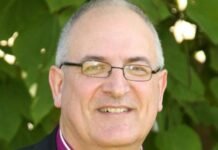
The Most Rev Mark Strange, Bishop of Moray, Ross & Caithness and Primus of the Scottish Episcopal Church responded to today’s announcement about the prospective prorogation of Parliament in early September as follows: “As the Primus of the Scottish Episcopal Church, I am very aware that Scotland emphatically voted to remain in the European Union in 2016. The implications of that vote affect our debate as a Church on the behaviour and practices of our leaders throughout this increasingly fractious time.
“I have struggled with the fact that Parliament is in recess while decisions about such important matters are being made around and outside it – people say to me that they simply cannot understand why the debate has stalled. I am therefore extremely uncomfortable at the request to prorogue Parliament at this time. I am increasingly worried that the apparent manipulation of parliamentary process seems to be becoming the norm in this debate, rather than full and frank discussion between elected members on a way forward for the whole country.
“In Scotland, this continuing uncertainty, alongside the majority wish to remain in the EU, will further fuel the debate on Independence, a debate that becomes more vocal as each day passes.
“The Scottish Episcopal Church will be holding a day of prayer as we approach the end of October. We will join with others in preparing for reconciliation in what is becoming an increasingly politically fractured society.”


Scotland is part of the United Kingdom, which voted to leave the European Union. As an outside observer it seems to me that many of those in various sorts of power and who are opposed to leaving have done all in their power to frustrate the will of the people. Mr Johnson wants to ensure that the referendum result is honoured in a way that does justice of the will of the people to leave. The proroguing of Parliament reminds me of 1975 when in Australia we had a position where the Government could not get Parliament to grant the money required to govern. The Governor-General (who has more power here than the Queen has in the UK) dissolved both houses of Parliament so that a full election could be held and the issue resolved. The situations are different, but there seems to be some parallel in the taking of unusual temporary action. The Primus of course speaks as a private citizen of Scotland and the UK. I hope he respects the will of the people.
Except of course it isn’t the ‘will of the people’. It was the will of only 52% who also had no idea what leaving the EU would involve. No plan for leaving was ever voted on. It was basically just a straw poll on a vague idea.
The C of E always has to achieve 2/3 majority for major decisions. If Brexit had achieved a 2/3 majority we might just about call it the will of the people. 52% voting on a vague idea is definitely not that.
But, Brexit is a very good direction for Britain to regain sovereignty from mind sucking parasites in Brussels. Just like the tearing down of the Berlin Wall it came out of no where as if the hand of God desired it. A hard exit may involve a couple weeks of confusion but big deal if you need to carry your passport or an enhanced drivers license. The US is not a member of the EU and yet the EU loves our trade and free defense dollars. Get with it old chap. A stiff upper lip and full speed ahead. Remember, a few years ago the sun never set on the empire from that little island.
Not a vague idea at all. The 17.4 million who understand how corrupt the EU is and what the “ever closer union” and “post-democratic era” of which the unelected dictatorial thieving bureaucrats in Berlaymont constantly speak actually means, desire a clean break.
17.4 million out of 46.1 million doesn’t sound like a convincing majority to me – or anything like enough to say it is ‘the will of the people’.
Ah, well, it’s a majority whether it convinces you or not. In Australia we have referendums to decide on changes to the Constitution and we know that 50% plus 1 overall, plus a majority in a majority of the six States, is the requirement for the Yes vote to succeed. Democracies usually work on majorities. Voting here is compulsory, but a percentage still don’t bother to vote. Those who didn’t vote on Brexit, apart from the very old or very sick or disabled, were apparently quite happy for a Leave vote to prevail, and it did.
When a referendum is held a vote of 50% plus one is usually regarded as the will of the people. How can you tell that the 52% had no idea of what was going on while the 48% did know? In Britain a referendum is actually a much more accurate gauge of public preferences than a Commons election because the first-past-the-post voting system doesn’t really allow for the preferences of all voters to be taken into account (in contrast to Australia’s superior preference system). A referendum with just a Yes or No response clearly indicates what the majority of those who bother to vote want.
I am “extremely uncomfortable” that Remoaners keep trying to thwart the will of the people and undermine UK sovereignty. I am severely uncomfortable with bishops so abusing their position.