
In the light of the address by the Revd William Taylor, Rector of St Helen’s Bishopsgate in the City of London, explaining to his congregation why he is not going to leave the Church of England, here is a practical scenario that really could happen to a large city-centre conservative evangelical church that chooses to stay in the denomination:
A CofE diocesan bishop receives notice from a conservative evangelical incumbent that, because she will not distance herself from the House of Bishops’ ‘good disagreement’ and ‘radical inclusion’ stance on human sexuality and the transgender issue, she and his church are now in ‘impaired communion’. The Bishop’s spiritual oversight is not welcome; in the eyes of the Rector, the other licensed clergy on his staff team and the church council, she is just a secular CEO or area manager.
But far from taking this on the chin, the Bishop is affronted because she believes the Church has bestowed on her an authentically spiritual oversight. She resolves to play hardball with this Rector, but she is clever about it and bides her time.
When his curate’s four-year licence comes to an end, she tells the Rector that he is no longer being allocated as a training incumbent. So he won’t get a first-time curate. One of his second-curacy clergy then decides to move on. The Rector gets in touch with the Bishop’s office to organise a replacement but is told that she is not going to license one.
The Rector threatens to withhold money. She tells him in impeccable episcopal-speak to get lost.
Five years later, the Rector retires. Via her Archdeacon, the Bishop tells the external appointing body for the large conservative evangelical church, its patronage trust, that she is not going to appoint a new rector. She is going to appoint a priest-in-charge instead, which means neither the patron nor the church council has the right of veto.
The Bishop makes sure she is assiduous in following the legal procedures because she knows there are lawyers in this large city-centre church. She is very careful to tick the right boxes.
The priest-in-charge she appoints on a fixed-term licence is a conservative evangelical with a young family whose curacy is coming to an end. He needs a house and a salary. She tells him he can have ministry reviews with the roving conservative evangelical assistant bishop she allows to minister in her diocese. So, the type of ministry the large church will receive is familiar.
But the ‘impaired communion’ declared by the previous incumbent is now irrelevant because the priest-in-charge is her appointee and if he wants to get bumped up to Rector, he needs her approval.
Comparing the denomination to a secular organisation like a golf club will not change the practical reality of the powers that CofE bishops have. In these terrible spiritual times for the CofE, the volunteers who faithfully serve the Lord Jesus Christ in large conservative evangelical churches continuing in the denomination should be told that.

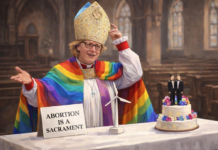


This is TEC episcopacy 101. Been watching this sort of thing for the last 15 years as the regular course of business in most dioceses in the US. Been warning my conservative friends in England for as long. The usual response until a couple years ago was “oh, dear, TJ, you must understand we are English. Such things just don’t happen here….”
Which is what they tried to do with me when we passed resolutions, but oh dear, I already had an ordinand in training who was already forward in faith.
We are not an evangelical parish, but if we were never under estimate the threat of withholding parish share. If a few other large evangelical parishes did the same in solidarity, let’s see how the bishop responds when her money runs dry and the only ones who can bale her out are those same evangelical parishes.
Or better still they just leave the CofE, start a new community of faithful anglicans and wave goodbye to the dear bishopette.
Bishops are a real hoot. They cause more problems than lives they enrich. They all claim to be promoting the church’s agenda or stratagem which in its self an oxymoron. TEC got in big trouble in America because it is such a lousy chess player; it couldn’t tell the difference between a bishop and a queen. If you are politically correct, please feel free to be offended.
Mr./Ms. Invisus- As they say, in many Protestant denominations, bishops are desirable but not necessary. However, for Anglicans, they are necessary, but often not desirable.
In any case, complaining about the behavior of bishops is as Anglican as complaining about the lesser Amantillados.
“…necessary, but often not desirable.” Exactly.
I believe AlphaTomega is male.
Yes Dr, I do see your point, given the discussion above.
It’s just necessary feedback. Foley Beech is the real deal. Have to hold my nose with Gene Robinson and most of the lady Bishops. As I have said before, the Anglican world would be much better if bishops were paid $500 per catechumen confirmed and then locked in a cell in a remote desert cave.
Unfortunately for TEC, those bishops found plenty of time to pervert the doctrine of the church and cut the size of the denomination in half in those 50 years.
So, the outcome has been that dioceses have staffs twice the size they used to be (to help with all that administration) and the TEC bishops have plenty of time on their hands to teach heretical doctrine, and destroy the few orthodox dioceses that survived the past 50 years.
Within TEC, yes, the apples are rotten. All, no, not quite. One lone bishop remains in the US, who is trying to maintain marriage as between one man and one woman. Two have maintained that position in non-domestic dioceses. TEC has taken disciplinary action (at this point, outside any authority of the canons or constitution, since no charges have been filed, but power is power). So it has established that the Christian position on marriage is no longer allowed.
7 or 8 others in the US and a few oversees maintain the teaching on marriage at the episcopal level, but allow their parishes to go their own way on the matter by allowing other bishops to “oversee” those parishes for the purpose of their non-Christian marriage ceremonies. They cannot even muster a “strongly worded letter” in defense or support of the one bishop in the US who is maintaining his vows to defend the Church against heretical doctrine.
90 dioceses of TEC in the US and some number oversees, and their bishops, have abandoned the Christian definition of marriage. 64 (as of about 2010, undoubtedly more now) permit communion of non-baptized persons. Many of those promote that particular heresy.
If the address by the Rev Richard Taylor, to which Julian Mann refers, signals that he has just discovered the Church of England has been all but taken over by the revisionist agenda and that he’s firing a warning shot to the hierarchy, he’s very late to the battle. In fact some would say the battle is already lost.
So the sudden musings about the value or validity of church denominations come across as a bit too convenient. It sounds as if a wealthy church is saying ‘we’re alright on our own because we’re well resourced and the denomination can’t touch us.’ As Julian’s piece shows, there may be a misplaced confidence in that assertion; I hope that it signals naivety rather than arrogance but I fear there may be a bit of both.
St Helen’s has a reputation as a leading evangelical church. It’s teaching may indeed be second to none. But either it’s in a denomination (the C of E) or it’s not. And, if it’s in, surely it has a duty of loyalty and care towards its Christian brothers and sisters across the land who share in the faith and witness for which that denomination is supposed to stand. It is (as a leading church) at least in some sense its brother’s keeper. Surely it cannot simply look to its own interest and ignore the plight of other hard pressed ministers and congregations.
So I genuinely wonder what it has been doing over the past 5 or 10 years to provide (or join in with) the essential, well coordinated leadership necessary to defend the Church of England against the revisionist onslaught which Richard Taylor correctly describes? Because many of us would say that the defining characteristic of that fightback has been silence.
All too true Don. Although it’s William Taylor rather than Richard Taylor, but given that he quoted Thomas Hooker as Richard Hooker – what’s in a first name?
Talking of large evangelical congregations located in the city center, I am surprised at the lack of response to liberal drift of the C of E by All Souls Langham Place or Holy Trinity Brompton. For those of you across the pond, am I mistaken that they are silent? If they are silent then why, it would seem they would have a great voice?
There’s quite a few of us here in the C of E who were once surprised about this, JRC. But no longer – we’re just used to it. Clearly all is not well in evangelical circles. As for what the reasons are, it’s difficult to speculate publicly when you don’t move in those circles; but that doesn’t mean we have no thoughts about what might have been going wrong over quite a long period.
Nicky Gumbel hasn’t preached a gospel which included anything at all about the holiness of God, His intolerance of sin, His being just, the reality of judgement, hell or repentance during his entire ministry. It’s God loves you. The 21st century gospel. See https://youtu.be/ajIDVt2MSO8 for a video I made about it. And another which tries to show where “God loves you” leads – and it’s antidote.
https://youtu.be/TcO5W2SqYuI
Nicky Gumbel has been considered evangelical because he was an evangelist I think – and because people saw what they wanted to see – like we do when we see a word with letters missing.
As to All Souls I don’t know but I wonder if their approach is an extension of the Stott approach to non-evangelicals being in the denomination. I made a video about that too.
https://youtu.be/w93eLTnL0n8