
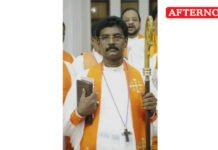
The Diocese of Wangaratta has passed their motion calling for the blessing of individuals who have taken part in a same-sex wedding. The voting, reported by prominent supporter of the motion Ven. John Davis (Archdeacon Emeritus of the Diocese), was that 67 for, 18 against and one abstention.
Davis has published his speech in support of the motion.

The “two men” that Davis refers to in his speech are himself and his long-term partner Robert Whalley. The packed country church is to be St Paul’s Milawa. The date is 2 weeks from today – 14 September 2019.
The invitations, sent out with the Diocese of Wangaratta crest upon them, refer to “a service of Morning Prayer with music, prayers and blessings appropriate to the occasion.”
The occasion is what will no doubt be the first of the blessings that the synod has just approved of, with Bishop John Parkes himself in attendance.
While davidould.net has known of this event for several weeks, we have chosen to only publish now that Davis himself has publicised the event. Were Bishop Parkes to preside in any way over this event it would only compound the sense of his break of collegiality with the other bishops of the national church and their hard-won agreement.
It is understood that senior conservative bishops are now almost certain to proceed with disciplinary measures against Bishop Parkes. We’ll try and keep the readers of davidould.net updated on these sad events.


If the blokes all start marrying each other, what is a sheila to do?
There may well be a blessing here- for 18 people.
Ah yes. Feel the love. But what ‘church’ is this? My bible takes a dim view of this kind of thing. But John and Rob are obviously not bible readers, or at least not bible-believers. So they must belong to the good old ‘church’ of the people who do whatever feels nice to them. Lots of flowers and candles and little statues of Jesus on the Cross. What was that Cross for, I wonder?
The Bible is clear that marriage is to be between a man and a woman. Jesus himself spoke of marriage being between a man and a woman. Homosexuality is also stated as sinful. It’s a shame to see Churches endorsement of sin as holy.
Says someone glorifying slavery. Oh, but slavery isn’t condemned in the Bible. So it’s a good thing. Right.
Who’s glorifying slavery? Homosexuality is a sin and it is clearly stated as such in the Bible. Marriage is clearly defined as between a man and woman. It’s not ambiguous.
Oh okay, try this amended version..(although what was wrong with my reference? It was relevant to the post.)
“Slavery under the Old Testament was not what we would recognise as plantation slavery or even Roman Empire slavery. In the days when food sources were dependent on the weather, life was much more precarious. Being an OT slave was more like being a bonded apprentice or servant, whereby you paid for your food and lodging and security with your service.
(Think Lionel Bart’s version of “Oliver!”)
Under the OT laws every seven years ‘slaves’ could be released to go free or choose to remain.
The New Testament writers could do nothing to stop slavery and had to live with it. It should also be borne in mind that slaves in the ancient Graeco-Roman world were often treated very well and if they weren’t slaves may have been in much worse conditions. The slaves who accompanied pupils to school seem to have had very easy days. Many slaves were treated poorly of course. Being a slave of even a bad master was usually better than being a “free” day labourer, for example. I would love to be given a quotation from a Christian “glorifying slavery”, as you put it..
Slavery under the Old Testament was not what we would recognise as plantation slavery or even Roman Empire slavery. In the days when food sources were dependent on the weather, life was much more precarious. Being an OT slave was much more like being a bonded apprentice or servant, whereby you paid for your food and lodging and security with your service. Under the OT laws every seven years ‘slaves’ could be released to go free or choose to remain. https://www.rationalchristianity.net/slavery_ot.html#forcedLife
Love the teeth btw
Oh okay, try this amended one..
“Slavery under the Old Testament was not what we would recognise as plantation slavery or even Roman Empire slavery. In the days when food sources were dependent on the weather, life was much more precarious. Being an OT slave was much more like being a bonded apprentice or servant, whereby you paid for your food and lodging and security with your service. Under the OT laws every seven years ‘slaves’ could be released to go free or choose to remain.
(Think Lionel Bart’s “Oliver!”)