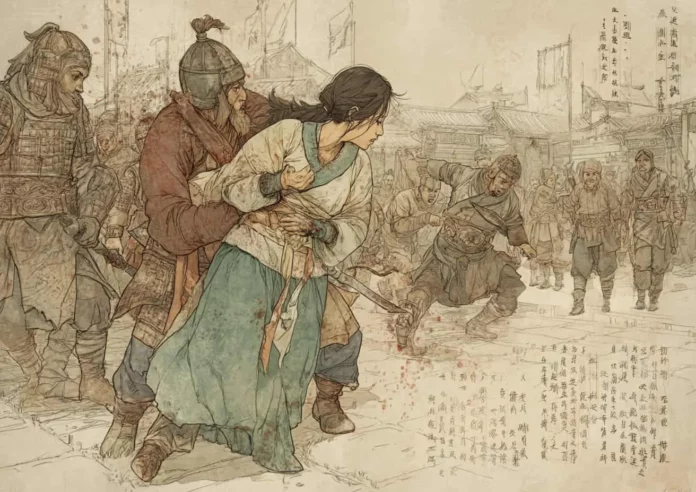

Towards the end of the 3rd Century, during the twilight of the Western Jin Dynasty, the imperial court of Emperor Wu desperately sought salvation.
Years of civil war and famine had left northern farmlands desolate and towns empty. The realm’s population had plummeted during the recently ended War of the Eight Princes, which had threshed the people like ripe stalks of wheat at harvest. Drastic measures were required to return the Jin’s strength to its former glory.
Desperate to restore his people’s numbers, the Emperor opened the realm’s gates to the tribes of the “Five Barbarians”—the Xiongnu, Jie, Di, Qiang, and Xianbei—inviting these foreigners to settle within his borders. Jin officials offered land and grain to the newcomers, resources that were redistributed from the native population, believing that an influx of these hardy nomads would revive the Jin economy and help defend the northern frontier.
At first, the policy seemed to work wonders. Families in the tens of thousands streamed through the mountain passes to claim new homes under the empire’s protection.
Abandoned fields sprang back to life as settlers ploughed the soil. Border garrisons swelled with fierce warriors now serving in Jin ranks. In Luoyang, courtiers praised the Emperor’s wisdom, which had led to this new revival. Yet a few seasoned Jin ministers watched in dread, whispering that such a cure might eventually become a poison. The newcomers, they said, lacked the same morals and values of the Jin, and illustrated how this could lead to a clashing of cultures in the future—yet these warnings were brushed aside amid celebrations of renewal.
But it wouldn’t be long until this prophecy would bear rotten fruit. As the years passed, the cultural fabric of the North began to fray. In market towns, Han villagers found themselves surrounded by the unfamiliar tongues and customs of the foreign tribes. Instead of integrating, the newcomers to their own ways, showing little respect for Jin traditions. Rumours spread of settlers clashing violently with natives, of crimes unpunished and sacred sites defiled. Yet the Emperor’s court, distracted by intrigues and feuds, paid scant attention.
Eventually, rebellion ignited like wildfire as the barbarian tribal leaders sensed weakness at the empire’s heart and turned against it. Once honoured by the court, a Xiongnu chieftain crowned himself king and cast off all loyalty to Jin; others followed, as the Di seized western provinces while Jie warlords carved out domains in the east. The very forces the dynasty had once fed, clothed, gave lands to, and armed, now thundered back as avengers. What had been welcomed as a solution to the empire’s woes became an onslaught from within.
At last, the barbarians reached the gates of Luoyang, the imperial capital. The city’s defences crumbled. Invaders poured into palaces and marketplaces, cutting down all in their path. The proud capital was left a smouldering ruin. In that fiery devastation—remembered as the Disaster of Yongjia—the Western Jin Dynasty was destroyed. No less, by people it willingly welcomed into its society.
The Western Jin’s well-intended gamble had backfired catastrophically. Cultural erosion, rising violence, and betrayal combined to tear the dynasty apart. Thus ends the tale of Western Jin’s downfall—a solemn warning that short-sighted decisions can consume even the mightiest of empires, in a shorter time than anyone could imagine.
We’re destroying ourselves.
I never intend to stoke tension or operate outside the realms of the factual.
Yet at the same time, I don’t believe in censoring myself when something needs to be said.
With this in mind, there will be those who will read these words who will brand me a racist, a bigot, cold-hearted, inconsiderate, or tar me with some other similar moniker.
So be it.
(*** Before you shoot the messenger, please note the comprehensive list of resources below backing up my claims in this letter).
I don’t say this lightly: Europe currently faces one of the most significant threats in its history. One that is taking us on a path to the total destabilisation of the entire continent, while destroying the future for our children, grandchildren, and beyond.
The threat? Mass migration.
Read it all in Abundantia